- Made in Canada
- Free Artwork & Mockup
- Fast Turnaround
- No Setup Fees
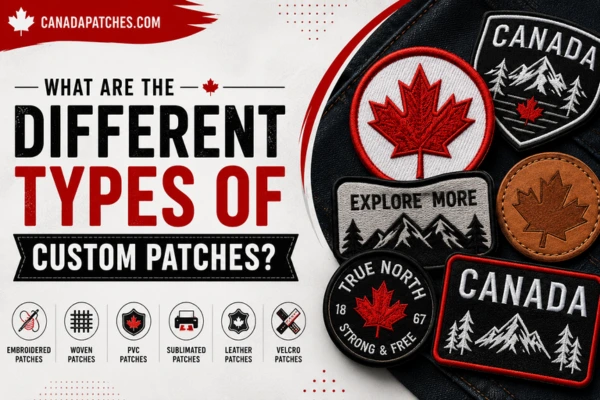
When selecting the types of custom patches to create, you should keep in mind that each type of patch comes with specific benefits depending on appearance, texture, durability, details, and cost. Custom patch is not only an element of clothing but also something that may be associated with an organization, company, team, occasion, profession, club, or even individual identity. By selecting the right construction technique, one can make sure that the final product will transmit all the design details and will be durable enough to withstand everyday wear.
For companies, organizations, sports teams, educational institutions, and individuals, Canada custom patches is a great option to make their designs, logos, names, and symbols wearable and durable.
Not all art works will require the same patch construction method. An art work such as a logo having clear letterings can turn out quite nice using embroidery construction, but an illustration art having fine detailing might look better using weaving construction method. While some artworks would do well being printed in a flat design, some will require raised textures that give an artistic three-dimensional effect to the artwork.
This will depend on the use that the patch is required to serve. A uniform patch would require durability to withstand cleaning and outdoor weather elements, but promotional patches would require great detailing and visual impact of the artwork. Knowing the attributes of both the options helps in determining which patch construction fits the specific purposes.
The process of patch construction includes choosing the appropriate base material, the designing of the art work, determining thread or printing options, the appropriate back of the patch and how it should be edged.
Embroidery is one of the most popular types of patches. It involves sewing the threads onto the backing fabric and thus results in textured material. The design will be given more depth and a classic look.
Embroidery is good to use when creating logo patches, badge patches, team patches, name patches, symbol patches, and designs with a strong outline. The texture is quite prominent and will be very noticeable on the jacket, uniform, cap, or bag where you have placed the patch.
The biggest advantage of this type of patch is its durability. The patches that are created correctly will survive frequent use. You may use them on workwear, sportswear, school uniform, club patches, and outdoors clothing.
Sometimes tiny text or very intricate artwork cannot be reproduced using classic embroidery due to the need of each thread for space. Thus, simplification of artwork will increase readability and make the patch look better.
Patches are made using thin thread materials woven together tightly to form a smooth patch surface. The woven patch will not have any thread material that is raised like in the case of an embroidered patch.
This kind of patch making is especially applicable when there are small lettering, details, fine lines or complex patterns in the art work. In this way it is possible for the small features to remain visible without any bulky parts caused by the embroidery process.
Custom woven patches are thus ideal for use by people who would wish to make use of polished looking designs. Such patches are typically used for making fashion labels, corporate branding designs, logos, event merchandise and other complex designs.
Ultimately whether to go for embroidery or woven patch is determined by the artwork itself.
Patches that are printed are an option for artwork that includes gradients, photos, shadowing, color change, or very intricate illustrations. Rather than mainly using stitches or weaved threads, the artwork is printed directly onto the patch surface.
This type of patch becomes very helpful when recreating artwork that may be difficult to reproduce with stitches or threads. Photos, watercolor art work, illustrations, and artwork that includes lots of colors will be able to retain their intricate design.
In addition, printed patches create a smooth surface that modernizes the artwork. They may be used by businesses to market products or hold events.
The printing technique, surface of the patch fabric, and finish process all play a part in the outcome. It is important to produce a high-quality product since bad printing will affect color accuracy and longevity.
Polyvinyl chloride patches are made of polyvinyl chloride, which is a durable synthetic rubber compound that forms a three-dimensional effect patch. The patches are very popular for use in outdoor applications, tactical clothing, sports gear, uniforms, bags, and other items that have to withstand harsh conditions.
Unlike traditional thread patch materials, PVC patches are water-resistant and may be much easier to clean up. Moreover, the solid surface makes it possible to introduce embossed and debossed areas into the design for the characteristic three-dimensional effect.
The PVC material is especially valuable when it comes to logos that require a contemporary and sturdy look. In particular, simple graphic signs, letters, organizational emblems, and other bold graphics usually go well with such material.
The material is also capable of providing consistent results throughout many batches.
Chenille patches are known for their soft, fuzzy feel and eye-catching design. The Chenille patches are usually used in varsity jackets, school sportswear, sports teams, clubs, or college-themed clothing.
Chenille does not emphasize fine artistry but instead pays attention to big shapes and colors and creates bold letters and color blocks. Because of the high-quality yarn being raised above the surface, the chenille patch has a plush texture which sets it apart from other patches.
It works best when you want your design to have an athletic and traditional look. Big initials, team logos, mascots, numbers, and other symbols may work well with the chenille design.
But in the case of complex designs, embroidery or weaving would work better.
Leather patches provide an elegant way to design in contrast to the fabric designs. A refined, premium, rustic, or minimalist design is possible using leather based on material, color, and finishing process.
The leather and faux leather patches are widely applied in various products such as hats, bags, jackets, outdoors items, hand-made products, and fashion accessories. It is usually possible to use embossing, debossing, engraving or printing of the logos on this material.
The simplicity of design provides an advantage to leather patches in case a brand does not want to apply vivid colors or graphics for their branding. A clear logo can express high-quality products through its presence.
The application of the faux leather provides an additional choice based on the requirements and needs of the product designer.
Comparing patch styles based on appearance alone can lead to the wrong decision. The intended application, artwork complexity, durability requirements, budget, and desired texture should all be considered before selecting a construction method.
| Patch Type | Best For | Appearance | Detail Level | Durability |
| Embroidered | Uniforms, teams, jackets, logos | Textured and raised | Medium | High |
| Woven | Fine text, detailed logos, fashion | Smooth and flat | High | High |
| Printed | Photos, gradients, complex artwork | Smooth and graphic | Very high | Moderate to high |
| PVC | Outdoor gear, uniforms, rugged branding | Rubber-like and dimensional | High for bold designs | Very high |
| Chenille | Sports, schools, varsity jackets | Soft and raised | Low to medium | High |
| Leather/Faux Leather | Fashion, hats, premium branding | Refined and textured | Medium | High |
This comparison shows why there is no universally best patch type. The most suitable option depends on the relationship between the artwork and its intended use.
For example, a sports team may prefer chenille for a varsity jacket, while a company with a detailed logo may choose woven construction. An outdoor organization could benefit from PVC, while a fashion brand might favor leather or faux leather.
Location can influence production preferences, turnaround requirements, and the type of supplier an organization chooses. Businesses and organizations looking for custom embroidered patches Toronto options may want to consider whether the supplier can reproduce their artwork accurately, provide suitable backing choices, and maintain consistent quality across larger orders.
It is also useful to evaluate the intended garment or product before placing an order. A patch designed for a lightweight shirt may require different specifications from one intended for a heavy-duty jacket or outdoor backpack.
Artwork preparation is another important consideration. Vector artwork or high-resolution files generally make it easier for manufacturers to interpret logos and reproduce important details. Before production begins, reviewing a digital proof can help identify issues with lettering, proportions, colors, and placement.
The backing is an important part of patch selection because it determines how the patch can be attached to its final surface. Different applications may require different attachment methods.
Sew-on patches provide a traditional and secure solution, particularly for uniforms, jackets, bags, and frequently used garments. Iron-on backing can make application faster and more convenient for suitable fabrics. Hook-and-loop backing is useful when patches need to be removed or replaced regularly, making it common for certain uniforms and equipment.
Adhesive backing may work well for temporary applications, promotional items, or surfaces where sewing is impractical. However, the durability of adhesive attachment depends heavily on the material and conditions in which the patch will be used.
Choosing the backing at the same time as the patch construction ensures that the finished product is practical as well as visually appealing.
Custom patches can function as small but powerful branding tools. A consistent patch design can help customers recognize a company, team, organization, product line, or community.
The most effective patch is one that balances visual identity with practical performance. A logo should remain recognizable at its intended viewing distance, lettering should be readable, and colors should complement the surface where the patch will be placed.
For businesses, patches can also extend branding beyond traditional printed materials. A branded patch on a uniform, cap, backpack, or promotional product can turn an everyday item into a visible representation of the organization.
The growing variety of patch materials and construction techniques gives organizations more creative freedom than ever. Instead of adapting every logo to one standard format, businesses can select a construction style that reinforces the character of their brand.
Start by examining the artwork itself. If the design has bold shapes and limited detail, embroidery or PVC may provide a strong result. If it contains fine lettering or intricate lines, woven construction may offer better clarity. Photographic or highly detailed artwork may be better suited to printing.
Next, consider the environment. Clothing that experiences frequent washing or outdoor exposure requires a construction method and backing capable of handling those conditions. Fashion products may place greater emphasis on texture and appearance.
Finally, consider the desired brand personality. Embroidery can create a traditional and professional appearance, chenille can communicate an athletic aesthetic, PVC can look modern and rugged, and leather can provide a premium feel.
There are many types of custom patches, but selecting the right one becomes much easier when design requirements, application, durability, and brand identity are considered together.
Custom patches offer far more variety than a single embroidered design. Embroidered, woven, printed, PVC, chenille, leather, and faux leather patches each provide distinct visual and functional characteristics.
The best choice depends on what the patch needs to communicate and where it will be used. Fine details may call for woven or printed construction, bold traditional logos may benefit from embroidery, outdoor applications can work well with PVC, and sports-inspired designs can stand out through chenille.
Understanding the differences between patch styles allows businesses, organizations, teams, and individuals to make informed choices rather than selecting a patch based solely on appearance. With the right combination of material, construction, artwork, finishing, and backing, a custom patch can become a durable and recognizable part of a brand or personal identity.
Talk to our patch experts

High quality. Fast turnaround. 100% satisfaction guaranteed.