Sometimes when there is pressure on equipment, little things make all the difference. The use of Canada custom patches ensures first responders a tangible way to label departments, positions, units, and organizations, thus ensuring an added durability to uniforms and gear. When dealing with police, firefighters, paramedics, and other emergency personnel, the emblem does more than just add an aesthetic appeal. At times, it should survive exposure to water, dust, multiple washing cycles, wear and tear, and harsh working conditions without getting distorted.
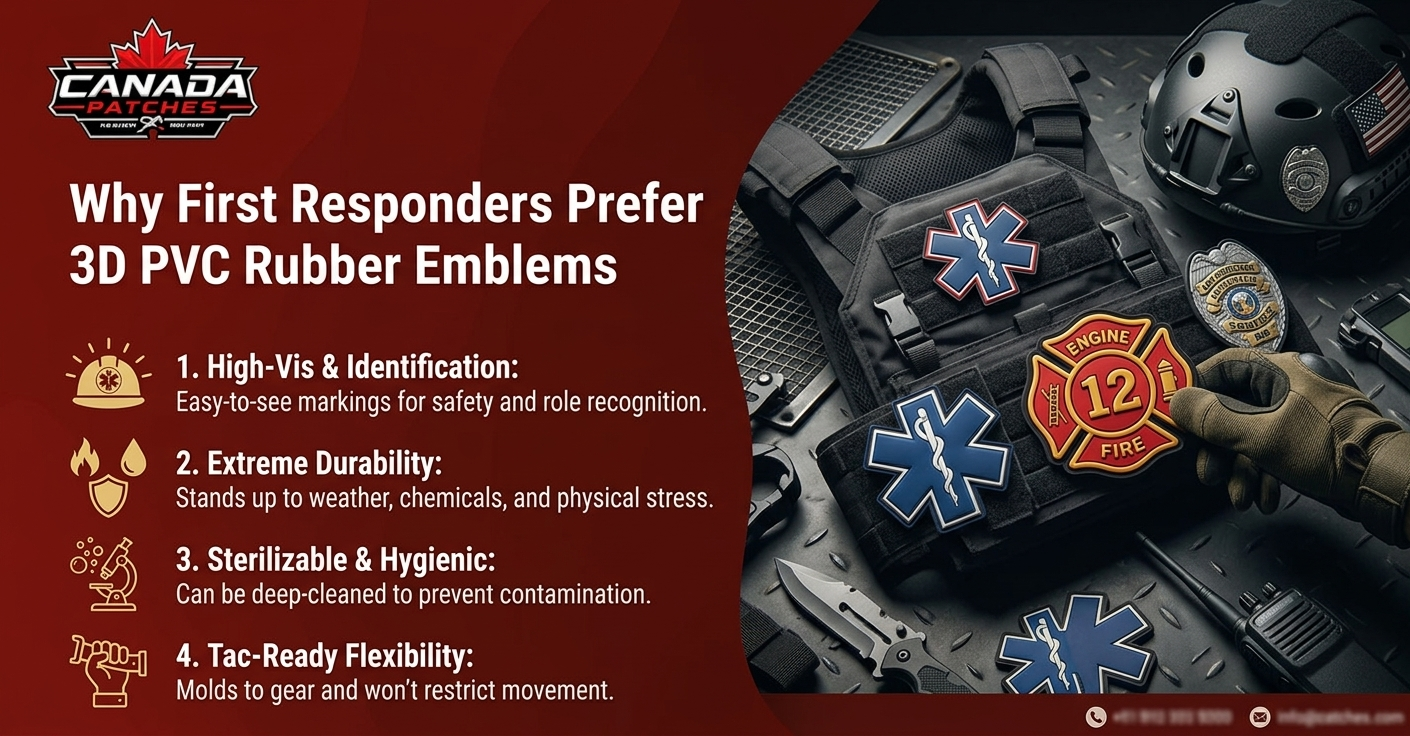
This is where the use of Canada custom patches in rubber and PVC material comes into play. While embroidered patches might not serve the purpose, molded rubber patches offer a raised texture even with bold text and other details in the design.
Why Do First Responders Need Patches That Can Handle More Than Appearance?
First responder uniforms and gear face elements not typically found in regular clothing. The patch will be exposed to moisture, dust, abrasion, sunlight, detergents, and rough surfaces during the entire period of use.
The fabric that appears beautiful while being new and rapidly fades in quality by unraveling and losing washability is inappropriate in this case.
Patches made of PVC and rubber materials resolve most of the above problems. Thanks to their molded form, they have an integrated surface, rather than the surface consisting of stitches. In addition, these patches fit perfectly well for uniforms, tactical bags, jackets, helmets, equipment cases, and similar items.
Thus, for first responders, this issue cannot be regarded as fashion but rather selection of the patch fitting the profession.
What Makes 3D Rubber Patches Easier to Read on First Responder Gear?
Another major advantage of 3D rubber patches is the dimensionality of the patches. The design doesn’t have to be presented on a two-dimensional surface; the specific parts of the design can be made three-dimensional in order to make some of them more noticeable.
For example, the name of the department can be made three-dimensional and stand out from the background, while the symbol will stay flat.
Borders, letters, numbers, and shapes can also vary in the level of the three-dimensionality.
That’s because of the necessity for the information to be transferred instantly.
The person who wears the patch can be the first responder, and the patch is likely to be placed on his tactical vest, jacket, equipment bag, or even on his uniform, where there is just a short time to notice the organization.
How Do PVC Emblems Perform in Rain, Dirt, and Repeated Use?
Not all situations can be controlled when it comes to emergency equipment usage. The weather might become an issue with rain, mud, snow, dust, and water.
It is here where molded PVC proves itself particularly handy.
It is much easier to wipe down the PVC surface than a heavily textured fabric one. It is more unlikely for dirt to get lodged between fibers, and it makes the construction stronger and capable of keeping the shape of the emblem during usage.
Thus, PVC patches Canada might be a good choice for those who want something both durable and easy to maintain when it comes to ever-changing weather conditions.
It is especially effective when the equipment in question is frequently exposed to external factors, such as tactical bags, emergency response coats, protective clothing, and field equipment.
Why Are First Responder Patches Better When Details Stay Clearly Defined?
Identification is one of the most important functions of first responder patches.
The police force, firefighting squad, paramedic squad, rescue team, or any other specialized squad might require its insignia to convey its identity right away. Should the detailed stitching begin to lose its tightness or should the small letters lose their readability, then the patch would become less efficient from a visual standpoint.
There is also the option of using molded rubber and PVC designs. In this case, instead of sewing the design out of threads, the design itself can be molded out of the material.
This works particularly well for:
Department names
Unit numbers
Emergency service symbols
Rank or role identifiers
Organization logos
Bold lettering
Tactical insignia
Memorial or commemorative designs
The goal is not to make the patch complicated. The goal is to make its most important information easy to recognize.
What Makes Custom Police Patches Suitable for Daily Duty Gear?
Police equipment is frequently exposed to friction and movement. Uniforms, outerwear, tactical vests, bags, and equipment cases can experience considerably more wear than casual clothing.
Custom police patches made with durable molded materials can provide a strong alternative where traditional embroidered patches may not be the preferred solution.
Adaptations can be made to fit the visual image of the department while still keeping the design functional. Lettering, shields, stars, department symbols, and other distinctive features can be used in creating the 3D patch design.
Consistency is another strength. If patches are needed by many people in one order from the organization, then having a molded design will ensure that there is uniformity throughout the order.
Why Are Firefighter PVC Patches Useful Around Protective Equipment?
Firefighters need equipment that is designed for demanding environments, and their identification systems should complement that equipment rather than becoming a weak point.
Firefighter PVC patches can be used on suitable areas of jackets, bags, helmets or accessories where an organization wants a durable visual identifier.
Typical designs for firefighter patches have powerful symbolism such as firefighter shields, crossing axes, fire flames, station numbers, maltese crosses, or department lettering. Such designs can be especially effective if combined with molded construction, which is naturally separated by raised and recessed areas.
What matters is location. The patch must be placed on an appropriate surface without impeding protective clothing, mobility, vision, or manufacturer specifications.
How Do Tactical Rubber Patches Help Gear Stay Organized and Identifiable?
Tactical equipment often combines multiple pieces of gear, making quick identification useful.
Tactical rubber patches can help distinguish teams, equipment, roles, or organizational affiliations while maintaining a rugged appearance. Their molded construction works well with simple symbols, text, flags, unit identifiers, and morale-style designs.
They can be particularly useful on:
Tactical backpacks
Plate-carrier-compatible gear
Utility bags
Outerwear
Equipment cases
Field jackets
Organizational gear
The key is choosing a design that communicates clearly without adding unnecessary visual complexity. A strong emblem normally relies on a recognizable shape, limited text, appropriate contrast, and a clear hierarchy between the main symbol and supporting details.
Why Is Easy Cleaning Important for Emergency-Service Emblems?
The first responder’s attire or equipment does not always remain clean for long periods of time.
There are different kinds of dirt, dust, soot, rain, grime, food, oil or other contaminations which may affect the equipment in its daily work. In addition, it is important to note that an emblem made of non-woven fabric material is more difficult to clean than a patch with a flat surface.
One of the reasons why molded patches have such popularity is their ability to resist dirt.
However, no matter how tough the patch material itself is, there should be specific cleaning recommendations for the garment or the equipment to which it is applied.
How Should a Department Choose Between 3D and Flat Patch Designs?
The right choice depends on the purpose of the emblem.
A 3D rubber patch is particularly effective when the design benefits from raised lettering, dimensional symbols, or a bold tactical appearance. It is also a strong option when the patch needs a solid, easy-to-maintain surface.
A design that is less flat can be considered in cases where the art contains minute details or is better done using another manufacturing technique, such as photography.
In this case, first responders need to start their deliberations on functionality rather than aesthetics.
Ask:
Where will the patch be worn?
Will it regularly encounter moisture or dirt?
Does the design depend on small lettering?
Does the department need a bold, dimensional emblem?
Will the patch be attached to clothing, equipment, or a bag?
Answering these questions makes it easier to select the appropriate material and construction.
Can Canada Custom Patches Be Designed for Different First Responder Roles?
Yes. Canada custom patches can be developed around different departments, units, roles, and applications.
A police force could use a shield logo. A firefighting service could use a station identifier that includes a symbol associated with firefighting. A search and rescue agency could need a highly visible emblem, while a tactical unit could prefer a more muted one.
The common denominator here is clarity.
An effective patch design must be able to convey its message without requiring its observers to figure out the overly complex graphic. Typography, proper spacing, identifiable symbols, and appropriate color contrast will do more good than any additional clutter would.
In case an organization orders several patches, consistency is equally important. All emblems must have identical proportions, typography, symbols, and visual hierarchy.
What Should First Responders Check Before Ordering Rubber Emblems?
Before ordering, it is worth reviewing the artwork and intended use together.
Start with the attachment method. Sew-on, hook-and-loop, adhesive, or another backing may be appropriate depending on the garment or equipment.
Next, consider dimensions. A design that looks clear on a large patch may become difficult to read when reduced.
Material thickness also matters. A highly dimensional emblem can look impressive, but the profile should suit the surface where it will be placed.
Finally, check the artwork carefully. Department names, station numbers, insignia, abbreviations, and other identifying information should be proofread before production.
For professional emergency-service gear, accuracy is more important than adding extra decorative elements.
Why Are 3D PVC Emblems Becoming a Practical Choice for First Responders?
The appeal of molded PVC and rubber emblems comes down to a combination of durability, readability, cleanability, and design flexibility.
They can give first responders a way to identify departments and teams without relying entirely on traditional embroidery. Raised details can make important elements more noticeable, while the solid construction is well suited to gear that experiences regular handling and outdoor exposure.
From custom police patches to firefighter identification and tactical team emblems, the material can be adapted to a wide range of professional applications.
Ultimately, the best patch is not simply the one that looks most impressive. It is the one that remains recognizable, suits the equipment, withstands its intended environment, and communicates the right information clearly.
For first responders, those practical qualities can make 3D PVC rubber emblems a smart choice for modern uniforms and operational gear.