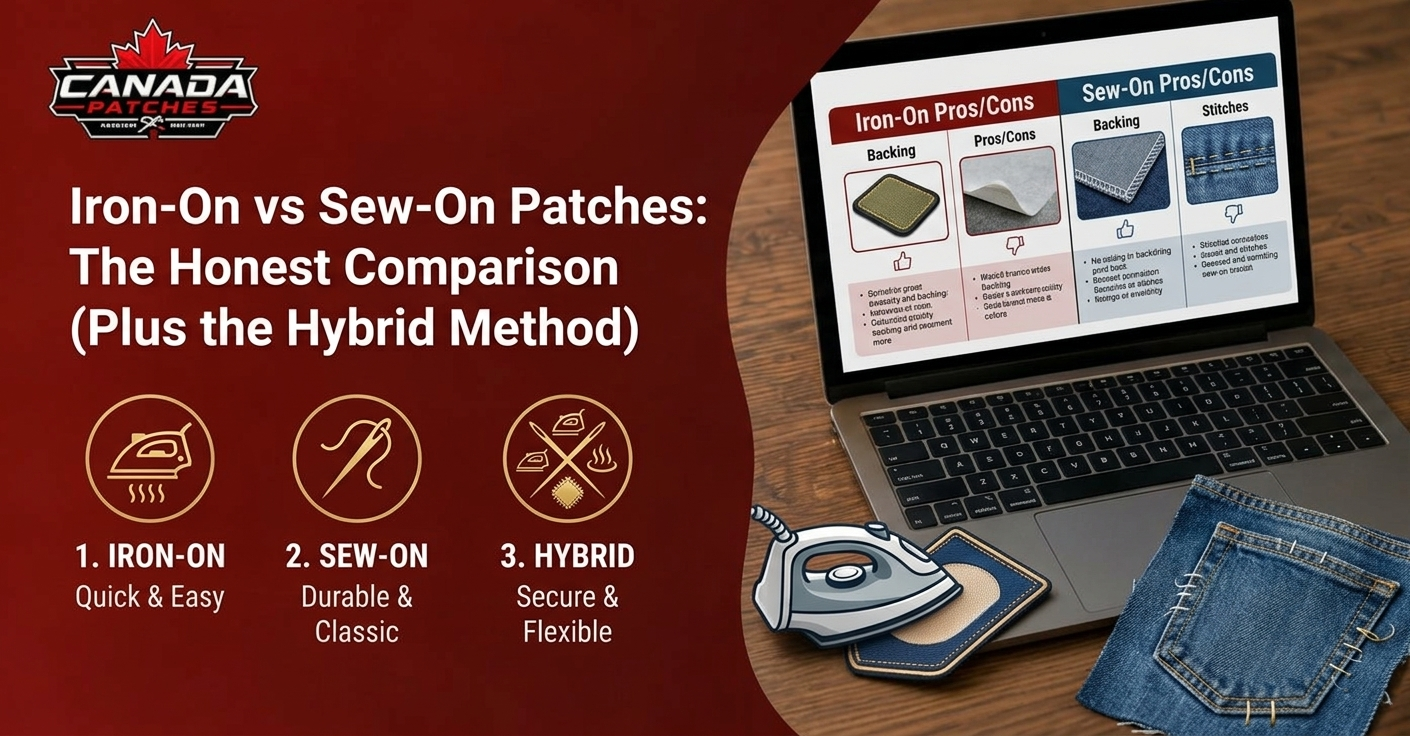
Iron-on patches stick to the fabric with the help of heat-sensitive adhesion, whereas sew-on patches are attached using the process of stitching and provide a much better mechanical grip. While selecting between iron on vs sew on patches, the following factors need to be kept in mind: fabric type, how often will it be washed, whether the patch needs to be worn everyday, and the desired finish.
Iron On vs Sew On Patches: What Is the Difference?
The iron-on patches come with an adhesive layer at the back that sticks to the fabric when heat is applied in accordance with the specifications. These patches are widely used to personalize jackets, embellish bags, repair fabric defects, and even apply logos without the need for a needle and thread.
The sew-on patches can be attached to fabrics by hand-stitching or with the use of a sewing machine. They do not use heat-activated adhesives and hence can be used in garments where high temperature is not advisable.
Knowing these differences will help you choose a substrate suitable for your project rather than picking one based on speed of application alone.
Which Patch Type Is Better for Different Fabrics?
Garment fabric is a key consideration when choosing a patch. Cotton and denim can be used in conjunction with the iron-on patches since they fit perfectly, while delicate, stretchable, coated, or heat sensitive materials might need a different way of attachment.
Cotton shirts: Iron-on patches might work if the material and adhesive are well-suited to each other.
Denim jackets: Either method may be appropriate, depending on the patch size and use.
Work clothes: Sewing is recommended if the clothing is being regularly washed.
Backpacks and canvas bags: Sew-on patches would be more secure in regard to movement and rubbing.
Delicate materials: Sewing would be less damaging than iron-on, unless the needle punctures the material.
Waterproof clothing: It is recommended to follow the directions of the clothing manufacturer because sewing can damage the protective layer.
Always check the patch instructions and garment care label before applying heat. Neither method is universally suitable for every textile.
Iron On vs Sew On Patches: Which Lasts Longer?
The difference in longevity mainly comes from the attachment mechanism. Iron-on patches rely on adhesive bonding, which can weaken under unsuitable washing conditions, repeated heat exposure, stretching, or poor initial application. Sew-on patches rely on thread passing through the patch and garment, creating a physical attachment.
In cases where clothes are subjected to a lot of washing or friction, sewing is the most durable method. However, an iron-on patch can be effective in holding up if it is done properly on the correct fabric.
The type of patch itself is equally important as any of the other factors mentioned above. Poor stitching, wrong threads, wrong adhesive, and faulty garment fabric can result in failure of the patch.
How Do the Two Methods Compare?
To compare iron on vs sew on patches, the following information will prove useful before placing your order or making any repairs.
Do Iron-On Patches Last Through Repeated Washing?
Certainly, iron-on patches may withstand multiple washings, but their longevity will depend on several factors such as the adhesive used, quality of the cloth itself, quality of the application process, and the wash cycle. Some of the patches stay intact for many years, whereas others start to peel off after just a few washings.
If you are asking do iron on patches last, the most important consideration is whether the adhesive forms a proper bond with the fabric. A patch applied at an unsuitable temperature or pressed for too little time may appear secure initially but gradually peel away.
There are several ways by which the life of the patch can be reduced:
Frequent cleaning using hot water.
Tumble drying the garment in case the glue cannot withstand the heat.
Bending or stretching the patch.
Rough areas that lead to continuous friction.
Fabric finish that makes proper gluing impossible.
Incorrect application and inadequate pressure.
Proper maintenance involves adhering to the manufacturer's guidelines, turning the clothing inside out whenever possible, and minimizing exposure to unnecessary heat.
Where the patch is meant for use on a uniform or piece of clothing that needs regular washing, it is best to sew or reinforce the patch rather than using only adhesive.
How Can You Make an Iron-On Patch Stay Secure?
Correct application is essential for reducing peeling and preventing the patch from shifting. Even a high-quality product can fail if the fabric is unsuitable or the manufacturer's instructions are ignored.
Here is a practical way of using iron-on patches:
Establish fabric compatibility. Make sure that the fabric is capable of withstanding the specified temperature. Not all synthetic fabrics are suitable for ironing.
Surface preparation. Make sure the garment is clean and dry. Follow the manufacturer’s guidelines for preparing the fabric.
Proper positioning. Lay the patch down carefully on a smooth and sturdy surface and ensure proper positioning before ironing.
Protection of the design. Follow the product instructions regarding the use of pressing cloth, especially if the patch includes intricate designs.
Use of the recommended heat. Apply the heat in accordance with the guidelines; do not try to increase the temperature arbitrarily.
Cooling of the patch. Follow the cooling instructions provided by the manufacturer.
Edge inspection. Check whether the edges are lifting or not adhered.
If you want to learn how to make iron on patches stay on, remember that careful preparation and correct application matter more than repeatedly reheating the patch. Additional stitching may improve security, but only when the garment and patch are suitable for that method.
Why Are Sew-On Patches Often Better for Heavy-Duty Clothing?
Sewing provides a direct physical connection between the patch and the garment. Unlike adhesive, thread does not depend on a heat-activated bond, which makes sewing particularly useful for clothing exposed to repeated washing, friction, and regular movement.
When evaluating sew on patches durability, consider thread quality, stitch spacing, patch weight, and the condition of the underlying fabric. A secure perimeter stitch distributes tension around the patch and helps prevent corners from lifting.
There are some practical benefits of using sew-on patches:
They are mostly applicable to uniforms and other clothes that need frequent washes.
A loose stitch can be easily fixed without the need for replacement of the patch.
They do not need any adhesive activation or any high temperature during the application.
They can be applied on various materials which cannot be heated.
Sewing is a time-consuming process and requires skill. Bad stitching may result in puckering, and patch removal may leave tiny holes in the fabric. Select your needle and thread wisely. Do not sew too tight stitches in order to avoid fabric puckering.
For demanding applications, test the attachment on a sample garment before applying patches across an entire uniform order.
Can You Combine Iron-On and Sew-On Methods?
Yes. The hybrid method combines adhesive application with additional stitching to create a more secure attachment. It is particularly useful for larger patches, frequently worn jackets, and garments that experience regular friction.
The process involves positioning the patch with its heat-activated adhesive, allowing it to cool, and then stitching around the perimeter. The adhesive helps hold the patch in place during positioning, while the stitches provide additional mechanical support.
These are the steps involved:
Ensure that the fabric and the patch will hold heat well.
Fix the patch in accordance with the instructions by the manufacturer.
Allow the adhesive to cool fully.
Inspect the patch, including its sides.
Stitch along the sides of the patch using the right needle and thread.
There will be minimal chance of lifting at the sides with this method, but there are some risks associated with failure as well.
Avoid applying heat to leather, heat-sensitive synthetics, or technical outerwear unless the manufacturer explicitly permits it. Sewing through waterproof membranes can also compromise their protective performance.
How Should You Choose Custom Patches for Canadian Projects?
When ordering your patches for your personal clothes, work uniforms, clubs, or promotions, think about the environmental conditions under which the final products will be used. In Canada, projects can be expected to include cold temperatures, rainy conditions, outdoor working conditions, and even seasonal changes in clothing.
For custom iron on patches Canada, check that the backing is compatible with the intended garment and ask the supplier for clear application and care instructions. Do not assume an iron-on patch is waterproof or suitable for every winter jacket simply because it adheres firmly at first.
For custom sew on patches in Canada, ask about border construction, backing material, stitch compatibility, and the intended garment. These details can influence the appearance, ease of attachment, and durability of the finished product.
Prior to ordering, it is important to assess the following:
Design quality: Ensure that lettering, logo, and other details are still legible at the chosen size.
Suitability of the backing: Verify whether the patch is meant for ironing, sewing, or both.
Quantities: Look at the minimum quantities for the order and bulk pricing for groups/businesses.
Sample test: Test on the garment prior to ordering in large quantities.
Washing requirements: Verify that the final product will be able to withstand its use.
Choosing the right backing before production may save time, money, and ensure consistent quality among multiple garments.
Frequently Asked Questions
Can You Sew an Iron-On Patch After Applying It?
Yes. If the patch and clothing material are appropriate for both techniques, then sewing can be done once the glue has cooled down. The process of sewing around the edges can serve as an additional reinforcement.
Can You Iron a Sew-On Patch?
Only if its material and decorative details tolerate heat. Ironing will not attach a patch that lacks heat-activated adhesive, so stitching remains necessary.
Which Patch Is Better for Work Uniforms?
Sew-on patches are generally preferable for uniforms that undergo frequent washing or demanding daily use. A hybrid attachment may also work when the garment and patch are heat-compatible.
Can Iron-On Patches Be Removed Without Damaging Fabric?
Removal is sometimes possible, but the result depends on the adhesive and garment. Residue, discolouration, or fibre damage may occur. Follow the manufacturer's removal guidance and test any recommended method on an inconspicuous area first.
Are Hybrid Patches Always More Durable?
Not really. Adhesive combined with sewing might provide better bonding strength, but it all depends on the quality of the material used.
Final Verdict: Which Attachment Method Should You Choose?
Choosing the best option between iron on vs sew on patches is entirely dependent on the intended use of the garment. Iron-on patches are convenient to use in suitable materials and for decoration purposes, whereas sew-on patches are usually more durable for uniforms, workwear, and clothes that require frequent washing.
Hybrid patching provides another alternative where both heating and stitching can be employed. Before making your order, assess the fabric type, read the instructions about the backing, and try out a patch sample under practical conditions. Proper attachment technique, application, and care will enable your patches to retain their quality for a longer period.