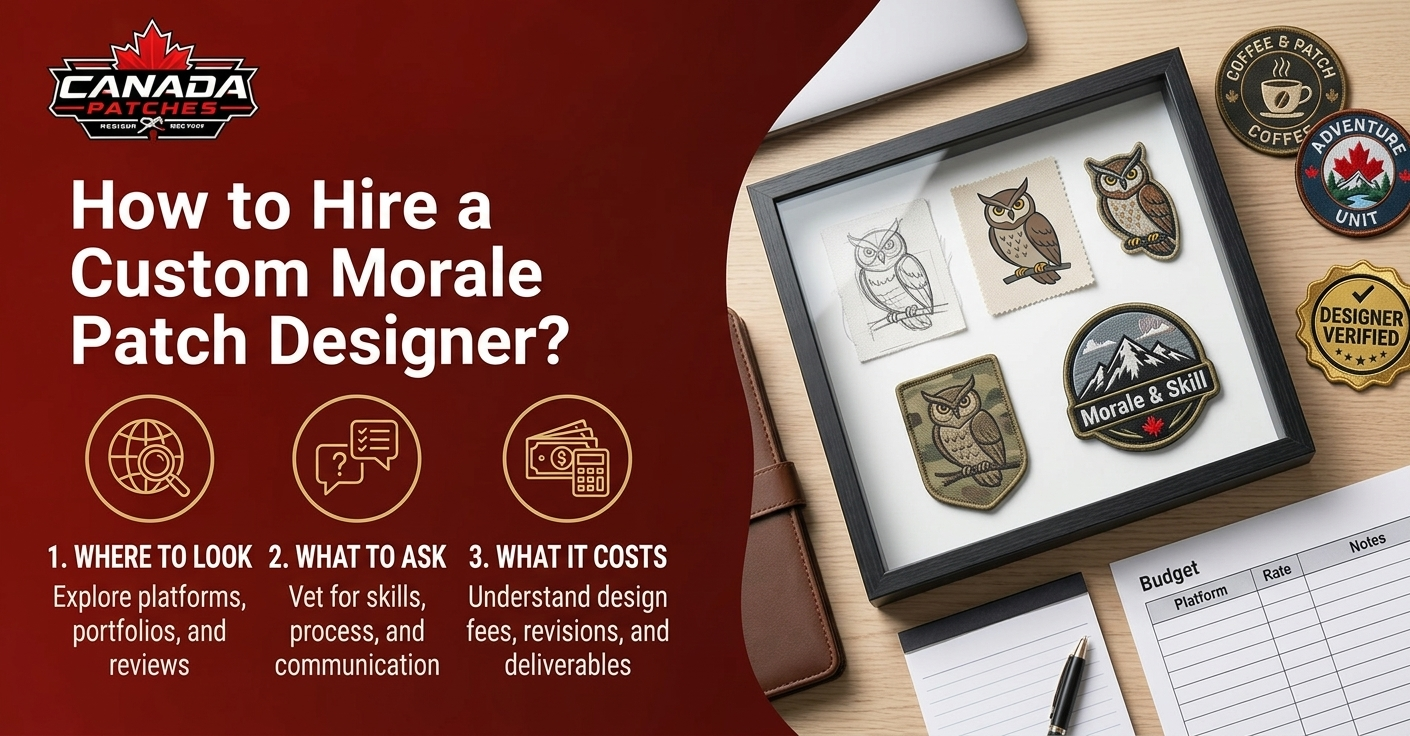
Selecting a custom morale patch designer requires you to find a designer who appreciates what you have in mind and who has knowledge about your design requirements and production capabilities. Before you hire a custom morale patch designer, make sure you establish your budget, your artwork requirements, your patch material, and other aspects of your project to save you from redesigning your patch.
The right designer is capable of turning a simple concept, an emblem, an illustration, and even your team's identity into a functional patch design. However, not every graphic designer knows how patches are made.
Why Should You Hire a Custom Morale Patch Designer?
Morale patches often communicate identity, humour, achievements, shared experiences, or team pride. Their designs may include detailed illustrations, short slogans, symbols, and distinctive shapes that need to remain recognizable at a small size.
While an average graphic designer could produce great-looking graphics for a computer, they would often miss the point on actual manufacturing needs. For instance, very tiny fonts, too many colours, and very complicated lines would not work well for embroidery and weaving.
An expert designer thinks about both aesthetics and feasibility. He or she is able to give appropriate recommendations and prepare the right files for manufacturing.
Professional design assistance is particularly valuable when creating patches for tactical equipment, outdoor clothing, clubs, gaming communities, businesses, or private collections. It can also help when an existing logo needs to be adapted for a different patch shape or attachment method.
Where Can You Find a Reliable Patch Designer?
Finding the right professional involves comparing relevant experience, portfolio quality, communication, and production knowledge rather than choosing the cheapest available option.
1. Explore Freelance Design Platforms
Freelance marketplaces are useful when you need several proposals within a specific budget. Search for professionals who specialize in embroidered patches, badges, military-inspired artwork, mascot illustrations, or merchandise graphics.
When you find a patch designer, look for complete portfolio samples rather than depending on their profiles. Select those whose designs have clear borders, legible text, good composition, and colours which stay distinguishable even when downsized.
Prior to making a purchase, make sure of the following:
If the designer had any patch art designs in the past.
How many revisions are there within the price offered?
Availability of editable files from the designer.
Commercial usage rights of the patch design.
The knowledge of the restrictions of embroidered/woven patches by the designer.
A designer with less number of reviews but experience with patch artworks is a better choice than a well-rated professional specializing in web and social media graphics.
2. Ask for Recommendations in Relevant Communities
Communities online for outdoor sports, gaming, collectibles, tactical gear, and even custom goods can be used to find designers with experience in your specific niche.
Ask members about their experience with design quality, turnaround time, communication, and final manufacturing results. If possible, request photographs of finished patches rather than evaluating digital previews alone.
Recommendations are helpful, but they should not replace your own checks. Confirm that the portfolio belongs to the person you intend to hire and that the proposed price covers your actual requirements.
3. Contact Patch Manufacturers Offering Design Assistance
Some manufacturers work with in-house designers, while others accept customer artwork or provide paid design support. This option can simplify the process because the designer may already understand the manufacturer's production equipment and technical specifications.
A morale patch maker may offer design assistance alongside manufacturing, although the scope and cost of that service can vary. Ask whether the design fee is separate from production and whether you can use the artwork with another supplier later.
This approach can be particularly useful for first-time buyers who are unsure about backing types, minimum text sizes, colour limitations, or file preparation.
4. Compare Canadian Custom Patch Suppliers
In the event that you are placing an order for a team, organization, or company from Canada, think about providers who understand your shipping needs, material preferences, and uses for the morale patch.
When choosing between providers of morale patches Canada, consider their shipping time, samples policy, minimum order quantity, copyright issues, and the availability of local support services. Using a provider in Canada might be easier to do, although it all comes down to quality and cost.
What Should You Ask Before Hiring a Designer?
A short discussion before payment can reveal whether a designer understands your requirements and can deliver usable artwork.
Can You Show Me Similar Patch Designs?
Ask to see examples that resemble your preferred style, whether it involves embroidered lettering, bold illustrations, cartoon characters, minimalist symbols, or detailed insignia.
Look for consistency in line weight, contrast, spacing, and hierarchy. In case the designer has only done generic illustration designs, find out how they will modify it to suit patch-making.
Do You Understand Manufacturing Limitations?
This is one of the most important questions to ask. Small text, narrow outlines, tiny gaps, gradients, and highly detailed images may need adjustment before production.
Ask whether the designer can simplify complicated elements without losing the original concept. They should also be able to discuss the differences between embroidered, woven, printed, and PVC patch artwork where relevant.
What Files Will I Receive?
Confirm the final deliverables before agreeing to the project. Depending on the manufacturer, these may include vector artwork, such as AI, EPS, or SVG, along with a high-resolution PNG or PDF preview.
Vector art files become very useful when the need to resize the art without blurring the images arises. The manufacturer might even have special requirements for file types and manufacturing ready files.
Check whether the cost quoted covers editable files, colour specifications, mockups, and revisions. A preview image will probably not be enough for manufacturing.
Who Owns the Final Artwork?
Ask whether you will receive commercial usage rights and permission to reproduce the design. If the artwork is intended for resale, merchandise, or organizational use, written clarification is especially important.
Also discuss fonts, stock illustrations, and other third-party elements. Make sure the designer has permission to incorporate them into the final artwork and that the licence covers your intended use.
How Many Revisions Are Included?
Request a clear revision policy before work begins. Some designers include a fixed number of revisions, while others charge extra for substantial changes after approval.
Give overall feedback rather than giving unrelated feedback via several messages. This will help control the cost and move forward with the project.
How Much Does a Custom Morale Patch Designer Cost?
Design costs depend on the complexity of the artwork, the designer's experience, the number of concepts, revision requirements, and the intended usage rights. Simple lettering usually requires less work than an original illustrated character with detailed shading and multiple design elements.
The following costs are approximate budgeting ranges in US dollars and not guaranteed quotes or market prices.
These prices only refer to design services and do not include manufacturing unless the provider states otherwise. Please make sure that taxes, licensing fees, rush orders, and source files are included.
What Additional Costs Should You Expect?
The design cost at first is just one element of the total budget. Manufacturing might require setup costs, MOQs, backing, packaging, delivery, and tax costs.
For example, a design that looks affordable on screen may become more expensive if it requires extensive revisions or specialized manufacturing. Ordering a small batch may also result in a higher cost per patch than placing a larger order.
Ask for an itemized quotation that separates design, sampling, production, and delivery. If you are ordering internationally, clarify the currency, shipping method, and any import charges that may apply.
Designer vs. Manufacturer: Which Option Is Better?
The optimal choice will depend on the necessity for artwork alone or a full cycle of service from idea creation until the completion of the project.
When making a decision on how to proceed, analyze the deliverables and the project budget. The bundled service does not mean a lower price and independent designer does not mean higher creativity. The main factor is the contract and abilities of the provider.
How Can You Prepare a Strong Design Brief?
It helps to minimize misunderstandings, increases speed of the process and prevents unnecessary changes.
The following should be provided:
Purpose: Clarify if the patch is intended for a team, event, uniform, collection or commercial use.
Concept: Provide a description of the main idea, visual concept, slogan, required symbols, etc.
Style: Provide sources of inspiration for colours, illustration style, typography, general design.
Dimensions: Provide information about approximate dimensions (width x height).
Material: Mention what material is more preferable embroidery, woven fabric, print, PVC, etc.
Attachment method: Mention what type of backing do you need (hook & loop, iron on, adhesive, sew on).
Budget and quantity: Clarify your design budget and approximate quantity.
Deadline: Clarify the date of the event or manufacturing deadline.
Provide reference images as inspiration rather than asking the designer to reproduce another person's protected artwork without permission. If your concept includes a slogan, make sure the wording is final before approving the design.
How Do You Check Whether the Final Design Is Production-Ready?
Before approving the artwork, review it at both full size and its intended physical size. Text should remain legible, important details should be recognizable, and colours should provide sufficient contrast.
Ask the manufacturer to confirm whether the design meets its technical requirements. This may include minimum line thickness, stitch density, colour separation, edge finishing, and acceptable file formats.
For large orders, ask for either a digital sample or a physical sample if one is available. This will allow you to compare texture, stitching, size, and colour. Never give approval to produce until you have everything in writing regarding the artwork, size, wording, backing, quantity, and price.
For buyers who prefer to coordinate design and manufacturing together, Canada Patches can be considered as a starting point for discussing custom patch requirements. Confirm the provider's current design assistance, production options, pricing, and artwork policies directly before making a decision.
What Mistakes Should You Avoid When Hiring a Designer?
Several common mistakes can create unnecessary costs or disappointing results.
Choosing solely by price: A low quote may exclude revisions, source files, or commercial rights. Compare the complete package rather than the headline fee.
Ignoring manufacturing requirements: Artwork that looks impressive digitally may not reproduce accurately in thread or other physical materials.
Providing vague instructions: Unclear feedback can lead to repeated concepts and delays. Use a concise brief with specific examples.
Failing to confirm ownership: Never assume that paying for a design automatically grants unrestricted reproduction rights.
Approving without checking the proof: Review every word, symbol, colour, and dimension before authorizing production.
Overlooking delivery costs: Shipping, taxes, setup fees, and minimum quantities can significantly affect the total budget.
Spending time to verify this information before making an order will go a long way in saving your money and preventing production headaches.
Frequently Asked Questions
How long does it take to design a custom morale patch?
A simple design could be completed within a few days, but more complex designs such as illustrations or conceptual designs could take a period of one to two weeks, or even longer.
Should I hire an independent designer or use a manufacturer's design service?
Choose an independent designer when creative flexibility or specialized illustration is your priority. A manufacturer's design service may be more convenient when you want artwork prepared for its specific production process.
Can I use my own sketch to create a custom patch?
Yes. A sketch can provide a useful starting point, even if it is rough. Explain the intended design, supply reference images where appropriate, and ask the designer to convert the concept into clean, production-ready artwork.
Do custom morale patch designs include manufacturing?
Not necessarily. Many designers charge only for artwork, while manufacturers may offer combined design and production packages. Confirm the exact scope of the quote before paying.
What file format should I request?
Vector formats such as AI, EPS, or SVG are useful for scalable artwork, while high-resolution PNG and PDF files can help with previews and approvals. Ask the chosen manufacturer which formats it accepts.
How can I avoid paying for unnecessary revisions?
Draw up a full brief, decide on the number of concepts and iterations, and collate your comments. Establish the visual direction early and request that it be approved in writing before starting.
Final Thoughts
Selecting the best designer entails more than looking at an eye-catching portfolio. You should take into consideration his experience, his communication skills, knowledge of production, licensing agreements, and the total cost of the entire project.
When you hire a custom morale patch designer, start by making sure that there is a clear brief and you have quotes that are similar and that the final output is confirmed in writing.