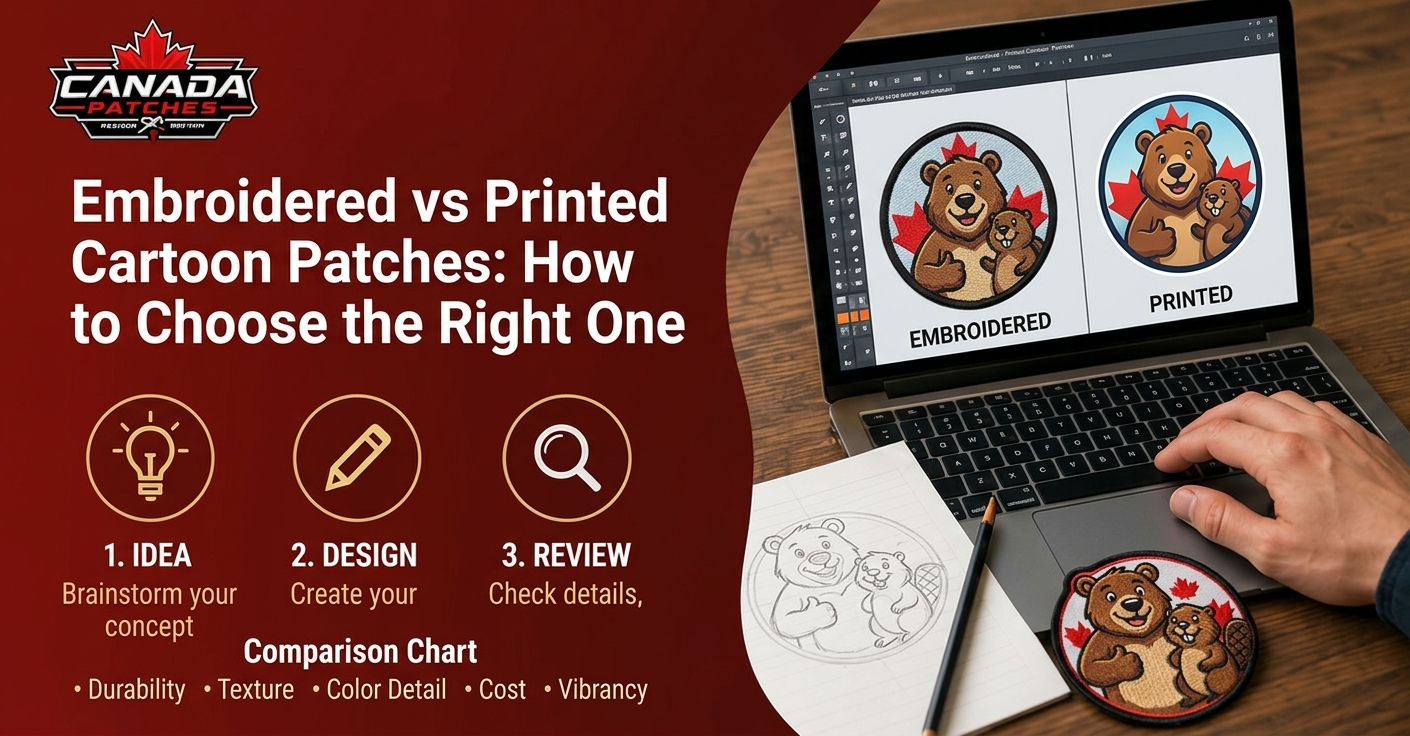
The difference between embroidered cartoon patches and printed cartoon patches is that embroidered cartoon patches have a three-dimensional appearance, while printed cartoon patches give better visibility to illustrations with their detailed images and color gradients. Knowing the differences between embroidered vs printed patches, you can easily make a choice based on your artwork, purpose of using the patch, the fabric, your budget, and aesthetic appearance.
It is common to use cartoon patches in jackets, backpacks, caps, children's clothes, uniforms, and promotional products. But using the wrong type of cartoon patches may lead to loss of details of characters' illustrations, lower quality of visual appearance, and increased expenses. It is important to know how the finished product will look in reality, how it will be applied, and how often it will be worn or washed.
What Is the Difference Between Embroidered and Printed Cartoon Patches?
Cartoon patches created using embroidery are those where threads of different colours are sewn to the fabric. Stitches help in creating outlines, shapes and patterns which make the design more textural and give a unique appearance to the character. Embroidered cartoon patches are suitable for bold designs, mascots, cartoon characters, animals and characters having colours which are clearly distinguishable from one another.
Cartoon patches that are printed are those created by different methods of printing which print the cartoons on the suitable fabrics. Print methods can copy fine lines, expressions, colourful backgrounds and even shadings without turning everything into stitches.
While deciding between the two methods, the factors that define your character should be considered. Cartoon bears having thick outlines and colour sections could look great when created using embroidery. Fantasy characters with tiny stars, intricate clothing and several color gradations would be easily reproduced using print.
Neither method is automatically superior. The right choice depends on whether texture, intricate detail, durability, or cost matters most for your project.
Why Does Your Cartoon Design Matter When Choosing a Patch?
Your artwork should guide the production decision because different techniques handle visual elements differently. A design that looks impressive on a computer screen may require adjustments before manufacturing.
For instance, thick borders and basic forms tend to suit embroidery designs well. Detailed facial expressions, intricate designs, and color blends can be better preserved via printing techniques.
Questions to ask before ordering include:
Are there small details or complex shadings in the character?
Will the patch be sewn on clothing, a bag, or some other material?
Should the image have a textured look or a smooth appearance?
Will the object face regular washing or outdoor conditions?
Is money a higher priority than obtaining a precise visual?
Such questions will help you understand your preferences and will prevent paying extra for unnecessary qualities.
Embroidered vs Printed Patches: Comparison Chart
The table below shows how both patches would compare regarding common criteria for purchasing such patches. Actual results vary depending on the quality of material used, production process, backing, finishing, and maintenance.
Use this table only as a guideline. A good patch of either type may work well in its particular circumstances when materials and construction are right for that application.
When Are Embroidered Cartoon Patches the Better Choice?
Embroidery makes for a great choice if the design requires a textured effect along with bold outlines.
1. Choose Embroidery for Bold Characters
Simple animals, smiling faces, cartoon characters and school mascots make good candidates for embroidery design. The distinct shape and color blocks of such characters can easily be translated into embroidery without compromising the likeness of the character.
For example, a cartoon dog that has a block of color in the body, dark outlines and big eyes makes a good candidate for embroidery. But then, small whiskers and intricate facial features might require some simplification.
2. Consider Embroidery for Frequently Used Accessories
Jackets, denim pouches, backpacks, and team apparel can all gain from an appropriate embroidered patch. Good sewing work and good edge sealing will help ensure that the embroidery resists wear and tear.
However, embroidery is not a product without any weaknesses. Unsecured thread, bad edge sealing, friction, and incorrect washing technique may harm your patch eventually. Please make sure you are using the correct backing for your item.
3. Select Embroidery When Texture Is Important
A raised surface can make a cartoon character appear more prominent and give the design a distinctive finish. This can be particularly appealing for decorative patches, mascots, and character merchandise.
If you are considering custom embroidery patches Canada, review examples featuring similar artwork and ask the supplier whether your character's important details can be reproduced at the requested dimensions. Confirm the backing, edge finish, and estimated production time before approving the order.
When Should You Choose Printed Cartoon Patches?
Printing is particularly useful when the artwork depends on fine details, multiple colours, or a smooth finish.
1. Choose Printing for Complex Illustrations
Cartoon characters with complex eyes, clothing, accessory, and background designs are just some of those whose designs can be effectively duplicated through printing, but not through embroidery.
One such imaginative cartoon character has a purple to blue shaded body, with stars, and faces with complex facial designs.
2. Use Printing for Gradients and Multiple Colours
Embroidery creates colour transitions through thread selection and stitch placement. Printing can generally reproduce a wider range of visual effects, including subtle gradients and complex colour combinations.
This makes printing useful for detailed character artwork, colourful illustrations, and designs that need to resemble a digital image closely. Final colour accuracy still depends on the printing process, material, and production settings.
3. Consider Printing for Small Visual Elements
Tiny facial features, delicate outlines, and intricate decorative details may become distorted when converted into stitches. Printing can preserve these elements more clearly when the finished patch provides enough space.
However, printed details can also lose clarity when a design is too small. Request a production-size proof so you can inspect the artwork at its actual dimensions before manufacturing begins.
How to Choose Custom Patches Without Compromising Quality
Understanding printed patches vs embroidered patches makes the selection process easier, but the production technique is only one part of a successful order.
Step 1: Review the Original Artwork
Look at the line work, the coloring, the faces and the fine details of the characters. If the drawing uses sharp outlines and colors, then embroidery may suit your needs. If it requires shading and detailing, then printing would do well.
Find out from the manufacturer if there is anything else needed to be done before production.
Step 2: Match the Patch to Its Intended Use
A decorative patch for a display item may have different requirements from one attached to a frequently washed jacket. Consider moisture, sunlight, friction, and laundering when selecting materials and finishes.
For children's products, also consider attachment security, age suitability, and any applicable product-safety requirements.
Step 3: Select the Right Backing
The popular ways of patching are sewing, ironing, and hook and loop patches.
Sewing: It works great when strong stitching is needed and fabric permits it.
Ironing: It works well when you can use your fabric according to the heat specifications.
Hook and loop: It works well when you need to remove your patch after some time.
Not all types of backing work with all fabrics. Please consider this while ordering.
Step 4: Compare Samples and Quotes
Request samples or photographs of past work with comparable artwork. Inspect line quality, color matching, edge finishes, stitching, and construction. Carefully compare quotes to determine what, if any, is included in the artwork preparation, setup costs, backing, packaging, shipping, and revisions. An inexpensive starting bid could end up not being the best deal after all.
If you are looking for premium custom patches in Canada, prioritise consistent workmanship, transparent pricing, clear communication, and production proofs rather than relying on promotional descriptions alone.
Step 5: Confirm Quantity and Delivery Details
The quantity produced may impact the set up cost as well as the cost incurred per patch. Larger quantities could result in reduced costs compared to smaller quantities depending on the supplier.
Ensure that the minimum order quantities, estimated delivery time, shipping costs, and replacement policy have been clearly stated before paying for the order.
Can You Combine Printing and Embroidery on One Cartoon Patch?
Yes. Some manufacturers offer hybrid patches that combine printed artwork with embroidered outlines or selected stitched details. This approach can preserve complex visual features while adding texture to important areas.
For instance, an image of the face of the cartoon character may have shading while borders can help bring the character to the forefront of attention through embroidery. Printed backgrounds together with letters created by stitching may be considered where applicable.
Nevertheless, hybrid prints may take extra effort to prepare and be more costly. Inquire from the manufacturer about the suitability of the combination for your art piece, its construction, and maintenance requirements.
What Mistakes Should You Avoid When Ordering Cartoon Patches?
Even with the best process for production, it will lead to disappointment if some vital considerations are overlooked.
Neglecting size specifications: Small details will be lost when scaling down the artwork.
Selecting on cost alone: Cheap production may sacrifice quality of materials used.
Neglecting artwork approval: Colors and proportion might not be what you expect.
Neglecting fabric suitability: Some backing and applying techniques can harm the garment.
Thinking that all patches can withstand washing: Maintenance needs are dependent on how they are attached.
Adding unnecessary details to the embroidery artwork: Too many small details might make the character unrecognizable.
For printing for cartoon patches, review the production proof carefully and confirm that the chosen material can reproduce the artwork at the required size. This simple check can prevent avoidable revisions and disappointment.
Frequently Asked Questions
Are embroidered cartoon patches more durable than printed patches?
That is not always the case. Good quality embroidered patches may provide great longevity, but even screen-printed patches can be long-lasting when using the right materials and finishes.
Which option is better for detailed cartoon artwork?
Printed patches are generally better for intricate illustrations, colour gradients, fine facial features, and complex backgrounds. Embroidery works particularly well for bold shapes and simplified designs.
Are printed cartoon patches cheaper than embroidered ones?
Costs depend on patch size, design complexity, materials, production method, and order quantity. Compare quotes using the same dimensions, backing, and quantity to make a fair assessment.
Can cartoon patches be ironed onto clothing?
Some patches have heat-activated backing, but not every patch or fabric is suitable for ironing. Follow the manufacturer's temperature instructions and check fabric compatibility. Sew-on attachment may be preferable for delicate materials.
How can I make cartoon patches last longer?
Use the recommended attachment method, follow washing instructions, avoid unsuitable heat, and inspect the edges periodically. Turn garments inside out before washing when recommended by the manufacturer.
Can I order cartoon patches in small quantities?
While some suppliers accept smaller orders, others require a minimum order quantity. Ensure that you know all the relevant details about the costs, samples, order quantity, and delivery time prior to ordering.
Final Verdict: Which Cartoon Patch Should You Choose?
When it comes to the choice between embroidery and printing, one must consider the type of artwork to be printed, its purpose, and the desired look. Embroidery works great for sharp graphics, texture, and classical stitching. On the other hand, printing is usually more suitable for illustrations, shadows, and multi-color artwork.
Prior to ordering a patch, you should analyze your design, compare samples, verify the material used as a backing, and receive a comprehensive quote. If you still feel unsure about which technique would work best for your design, then you could consult with the manufacturer. This way, you will save yourself unnecessary time and money.