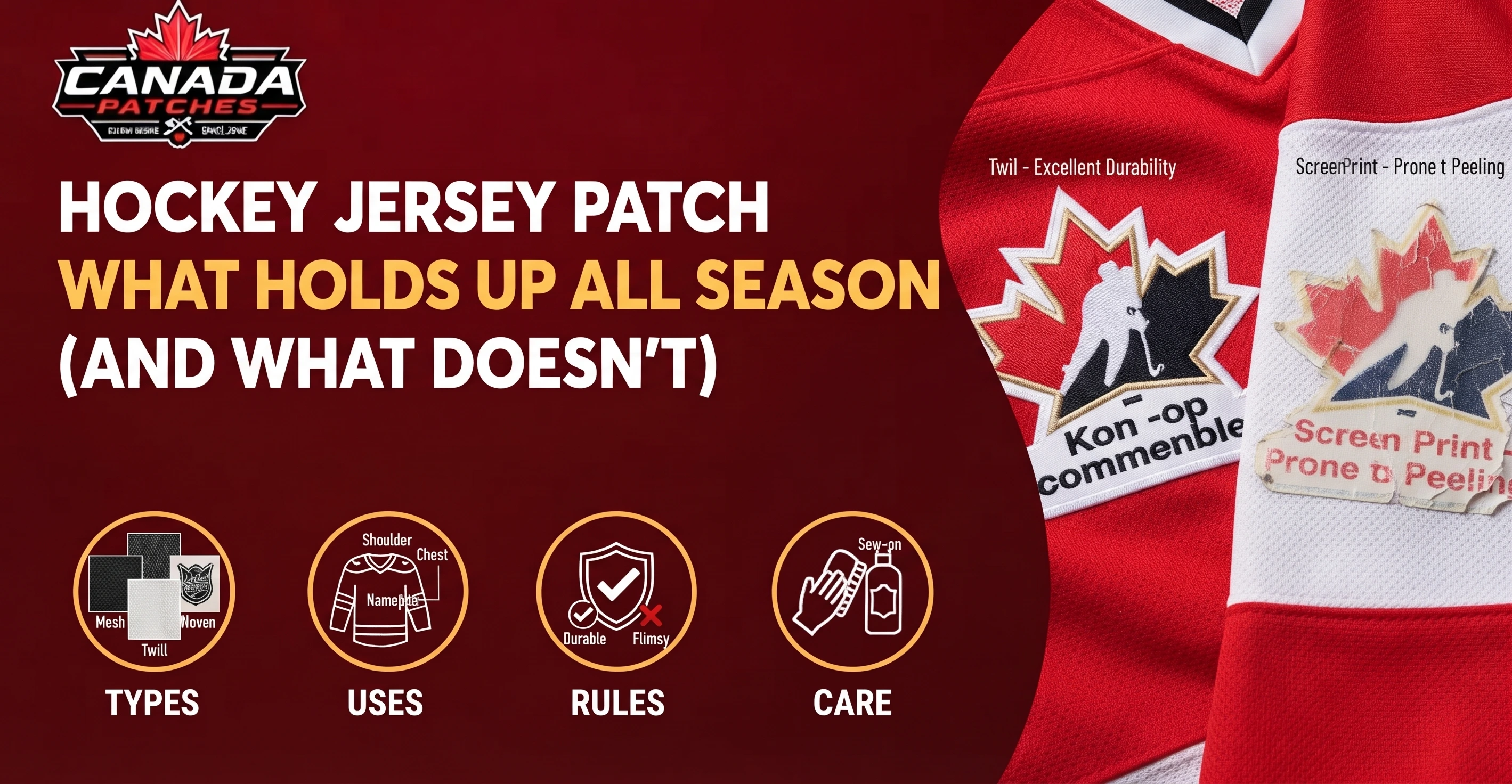
Suitable hockey jersey patch materials for an entire season include sturdy polyester tackle twill material, quality embroidery, woven fabrics, and properly treated sublimated fabrics. The choice depends on the particular design, the way the jersey is made, the way the patch is attached to the jersey, and how often it is used. While some patches can resist repeated use, washing, and handling, other patches might deteriorate.
The hockey uniforms have to endure a lot during a season of playing. Players will constantly move, stretch, bump into other players, and wear protective gear that may rub against decorations. Therefore, choosing appropriate patch materials is crucial.
Tackle twill hockey patches are one such form that utilizes fabric pieces sewn onto the backing of a patch by means of stitching. The result is a classic raised look and is very appropriate for hockey players’ names and numbers along with other graphics. However, the performance of these patches in terms of everyday wear is determined by factors such as material thickness and stitching.
Why Do Hockey Jersey Patch Materials Matter for Season-Long Durability?
The materials of various patches will react differently when exposed to moisture, friction, laundering, and physical movement. A material that is suitable for promotional clothing will not necessarily perform similarly when used for sports gear.
In addition to ensuring that the patch does not fall off, the patch must retain its size, colour, stitching, and flexibility through each use. The patch must also stay comfortable for use without making the patch stiff and uncomfortable against the player’s body.
There are various factors that determine the effectiveness of a patch:
Fabric: Sturdy and appropriate fabrics will help in retaining the quality of the patch.
Edge construction: Well-constructed edges minimize chances of fraying and falling apart.
Back material: A good back material helps in keeping the design in place.
Installation process: Safe installation minimizes unnecessary movements leading to early detachment.
Maintenance process: Appropriate cleaning and drying procedures aid in preserving the design.
By comprehending these elements, one can evaluate different construction processes rather than picking patches solely on their looks and cost. For a broader overview, see what materials are used to make custom patches.
Which Hockey Jersey Patch Materials Offer the Best Performance?
There are various choices of sports uniforms available that have their own strengths. It is important to choose an option depending on the type of artwork, size of the patches, budget, and playing conditions.
1. Polyester Tackle Twill: Best for Traditional Team Uniforms
Polyester tackle twill is very common in making letters and numbers on sports uniforms. Polyester tackle twill involves cutting out a piece of material in a particular design and attaching it to another material by stitching.
From its construction, it has a unique appearance that suits the typical attire of a hockey player. Polyester is the most suitable material for this purpose because it is durable and withstands tears and wear; it holds colors well and is flexible.
Benefits:
Great for large letters, numbers, and graphics.
Gives a classic fabric look.
Edge-stitching keeps the material from fraying.
It comes in different colors and finishes.
But several layers will make it thick and rigid. Teams must be careful about size and location while decorating their jerseys.
2. Embroidered Patches: Best for Team Logos and Detailed Designs
Coloured threads are embroidered into a base fabric to form logos, symbols, letters, and embellishments. The raised surface gives a professional look and is especially suited for sportswear branding.
Nevertheless, the high level of embroidery gives this technique resistance to wear and tear provided proper material of thread, base fabric, and seam finishing were used. Another major advantage of embroidery is its versatility.
Main advantages:
Creates a textured and professional finish.
Suitable for logos, symbols, and lettering.
Offers different thread colours and stitching styles.
Provides a substantial appearance for smaller designs.
Limitations include the fact that heavy embroidery can be relatively heavy and rigid. Lettering can be hard to see if there is too much stitching in the design.
3. Woven Patches: Best for Fine Details and Small Text
Woven patches are made using the weaving process that involves the interweaving of threads to make a pattern within the fabric. Unlike embroidered patches, woven patches are flat and have more detailed designs.
This type of patch is most ideal when there are complex symbols, thin lines, or small writing on a team logo. The lightweight nature of woven patches makes them appropriate where thick patches cannot be used.
However, woven patches do not provide the same raised texture as embroidered or tackle twill designs. Their appearance may therefore be less suitable for teams seeking a traditional, heavily textured uniform finish. Not sure which suits your crest? Compare embroidered vs woven patches.
4. Sublimated Patches: Best for Complex Colours and Graphics
Sublimation transfers colour into polyester fabric through a controlled heat process. It allows manufacturers to reproduce detailed artwork, gradients, multiple colours, and complex illustrations without relying on thick surface embroidery.
The reason is that the dye becomes a part of the fabric itself; therefore, the print will not have those surface-level peeling issues associated with some printing techniques.
However, this process by itself does not necessarily mean that the patch itself will be durable. The quality of the fabric, the finish of the edges, and the method used to attach it play an important role. For more on how sublimation compares with other finishes, read about sublimation and chenille patches in Canada.
5. Heat-Transfer Patches: Best for Lightweight Applications
Heat-transfer patches use heat-activated adhesive to attach decorative designs to suitable fabrics. They offer a smooth finish and generally require less installation work than traditional sewn patches.
They are very useful for uniform purposes, lightweight clothing, and occasional-use jerseys. But continuous washing, heating, and stretching may cause weakening of the adhesion bond.
This construction is not ideal for teams who will play frequently and have to wash their jerseys. For such teams, it is important to test the quality of the adhesive.
Hockey Jersey Patch Materials Compared: Which Option Should You Choose?
Comparison of properties allows teams to determine the material that would be most suited for their uniforms. The table below gives an overview of the major differences.
Material | Strengths | Weaknesses | Ideal for |
Polyester tackle twill | Classic, durable fabric finish | Several layers make it more rigid | Names and numbers |
Embroidery | Raised, professional look | Heavy stitching makes it heavier | Logos and crests |
Woven fabric | High quality of details | Flat appearance | Small text and graphics |
Sublimated fabric | Very detailed and colorful | Needs special edge finishing | Artwork with high complexity |
Heat-transfer material | Soft and light | The glue gets weaker | Temporary uniforms |
Every material suits every design and, therefore, there is a need for different materials. Tackle twill and embroidery are ideal for classic team uniforms, whereas woven and sublimated fabric offer more opportunities for complex designs.
Which Patch Materials Are Best for Different Jersey Designs?
Patch design should take into account the objective, size, and location of the design. A chest patch design requires different considerations from a sleeve or sponsor patch design.
For example, hockey team sponsor patches should preserve readable lettering and accurate brand colours without adding unnecessary weight. Woven and sublimated materials can accommodate detailed artwork, while embroidery may be more appropriate for simpler designs that benefit from a textured finish.
Varied applications come with varied needs:
Numbers of the players: Tackle twill gives you an old-fashioned look and is suitable for making big, bold numbers.
Team logos: These may be done through embroidery or sublimation.
Sleeve graphics: Here, lightweight woven or sublimated materials may be considered.
Sponsor graphics: Choice of material should take into consideration readability, colour fidelity, and attachment.
What Should You Consider When Selecting a Hockey Jersey Crest?
A hockey jersey crest patch is often the most noticeable decorative element on a team's uniform. It should maintain its original shape, colours, and construction throughout the season.
Take into account the artwork’s complexity, size, backings, and attachment needs when choosing the crest. Large crests should not make the jersey rigid across the chest area, while complex logos may need weaving or sublimation for a detailed look.
The finish of the edges is another aspect to think about. Sturdy stitching ensures that the design will not come off easily and retains a clean look. It is recommended for teams to ask for a sample first.
Iron-On vs Sew-On Hockey Patches: Which Attachment Method Lasts Longer?
Material quality alone does not determine how long a patch will remain secure. The attachment method also affects performance, particularly when uniforms experience frequent movement, washing, and physical contact.
When evaluating iron-on vs sew-on hockey patches, teams should consider convenience, fabric compatibility, expected usage, and long-term maintenance. Our full guide on iron-on vs sew-on patches also covers the hybrid method.
Iron-on attachment uses heat-activated adhesive to bond a patch to the jersey. It is generally quicker to apply and can provide a smooth finish. However, repeated washing, stretching, and excessive heat may weaken the adhesive over time.
Sew-on attachment uses thread to secure the patch directly to the garment. It creates a mechanical connection that does not depend entirely on adhesive strength. This makes it a dependable choice for frequently used team uniforms.
Comparison criterion | Iron-on | Sew-on |
Application process | Heat and pressure | Needle and thread |
Fixing time | Faster | Slower |
Reliability over time | Dependent on the adhesive quality | Better |
Washing multiple times | Adhesive gets weaker | Can usually withstand multiple washes |
Repair | Often needs reapplication | Loose stitches can be fixed |
Usage | Casual clothing | Sport uniforms |
In cases where the product needs to last throughout the entire season, the latter method proves to be a better choice. Many manufacturers also use both adhesion and stitching for convenience.
How to Attach Patches to a Hockey Jersey Without Damaging the Fabric
Knowledge of proper patch attachment on hockey jerseys will help to ensure the preservation of the material as well as the jersey itself. The patch attachment procedure must be carried out in accordance with the directions provided by the manufacturer and taking into consideration the jersey material. If you plan to stitch patches yourself, learn how to sew patches like a professional.
Follow these steps:
Check the jersey material: Identify whether the garment uses polyester mesh, air-knit fabric, or another performance textile.
Determine placement: Mark the intended position and check alignment before installation.
Prepare the surface: Ensure the area is clean, dry, and free from wrinkles.
Choose the attachment method: Select compatible stitching or manufacturer-approved heat application.
Secure the edges: Check that the entire perimeter is properly attached.
Inspect the finished patch: Look for loose threads, adhesive separation, uneven placement, and fabric distortion.
During the use of a heat press machine, the required temperature, pressure, and duration must be maintained. Too much heat may affect the artificial fibre of the fabric or the decorated jersey.
Where high-cost uniforms or jerseys are concerned, professional installation is advised; do not use an ordinary iron.
What Patch Materials Work Best for Captain and Team Identification?
Captain identification requires a recognizable design that remains securely attached during regular gameplay. These patches are generally smaller than chest crests and should complement the overall uniform design.
Hockey jersey captain patches are commonly produced using fabric lettering, embroidery, or tackle twill. The best option depends on the desired texture, size, colour contrast, and jersey construction.
Uniforms need to focus on consistency in their dimensions and positioning. This is because the final design needs to be clear and at the same time avoid adding any unnecessary bulk or hampering the movement of the player.
Consistent production specifications will make replacements simpler in the future. In this case, everyone on the team has the same design, the same materials, and the same production process.
How Can Teams Make Their Hockey Jersey Patches Last an Entire Season?
Even high-quality materials require proper care. Sweat, moisture, friction, and repeated washing can gradually affect decorative surfaces, stitching, and adhesive bonds.
Teams can increase the life of the patch through several maintenance procedures:
Turn the jersey inside out before washing to decrease friction.
Wash in cool or cold water using a gentle soap.
Do not use chlorine bleach or too much fabric softener.
Do not stuff too many jerseys into the washer.
Keep patches clear of exposed hook-and-loop fasteners that might snag threads.
Air dry jersey whenever possible or follow the garment’s low-heat instructions.
Check patch edges periodically and mend any loose stitching to avoid further damage.
Another factor to consider is storage. Jerseys that are wet or sweaty should not be kept compressed in bags for equipment for long periods. This will help reduce the development of odours and unnecessary wear on decorations. For more wash and winter care tips, see how to protect logo patches in Canada.
What Should Teams Consider When Ordering Custom Hockey Jersey Patches?
Purchasing patches for the whole group should be done taking into consideration such factors as the uniformity of material, quality of manufacture, size, and compatibility of fastening. Selecting a company just because it offers the cheapest patches may lead to problems with uneven colors, wrong backing, or rough edges.
Teams researching custom jersey patches in Canada should evaluate the following requirements before approving production:
Material specifications: Confirm the fabric, backing, embroidery density, and finishing method.
Artwork preparation: Provide clear artwork with accurate team colours and appropriate design dimensions.
Sizing and placement: Establish consistent measurements for chest, sleeve, and shoulder designs.
Attachment requirements: Confirm whether patches are intended for sewing, heat application, or combined installation.
Production samples: Review a finished sample before authorizing a larger order.
Replacement availability: Consider ordering additional pieces for future uniform replacements.
When sourcing custom hockey jersey patches, the production method should match the team's actual requirements rather than simply the lowest available price. Investing in suitable materials and secure construction can help reduce replacement costs during the season.
The last check for quality must include color, stitching, edge finishes, flexibility, and compatibility with the jersey material. This will ensure that any defects will be found before patches are spread out among the whole team.
Final Thoughts: Which Hockey Jersey Patch Materials Should You Choose?
Selecting suitable hockey jersey patch materials depends on several factors like durability, look, flexibility, and maintenance needs. Tackle twill made from polyester is ideal for traditional letters and numbers, while embroidery works fine for three-dimensional logos. Woven and sublimated materials have their own benefits when used for intricate designs.
If your team plays in competitive uniforms, it is important to use good-quality materials, proper stitching, the right backing, and proper maintenance of hockey jerseys to make them last as long as possible.
Frequently Asked Questions
1. What is the most durable material for hockey jersey patches?
Polyester twill and embroidered fabric provide two safe choices for uniforms that are used regularly by hockey players. The lifespan of the material will depend on its quality and maintenance methods.
2. Are embroidered patches better than sublimated patches?
Neither option is universally better. Embroidery provides a traditional raised texture, while sublimation reproduces intricate graphics, gradients, and multiple colours with a smooth finish. The appropriate choice depends on the design and intended appearance.
3. Can iron-on patches withstand an entire hockey season?
They can be secured through proper use of adhesive and application. But their re-washing, movement, and overheating can reduce their adhesion. The better choice in such cases would be sewing or using both stitching and adhesive methods.
4. Do tackle twill patches fade or fray?
Quality tackle twill generally maintains its appearance through regular use when properly manufactured and attached. However, exposed edges, inadequate stitching, harsh washing, and excessive friction can contribute to deterioration.
5. Can hockey jersey patches be replaced without damaging the uniform?
Yes. Old and worn patches can usually be carefully stripped off and replaced. This should be done carefully to prevent cuts in the jersey fabric or damage to the stitching and glue.
6. How should hockey jerseys with patches be washed?
Turn the jersey inside out, wash in cold water using a mild detergent, never use bleach, and dry clothes outside whenever possible. Be sure to follow the care guidelines recommended by the garment and patch manufacturers.