Selecting the correct patch involves knowledge of the materials to make custom patches, the design of artwork used, and the intended purpose of the final product. The Canada custom patches can involve the use of embroidery, intricate sublimation designs and textured chenille lettering among others, which produce a unique combination of color, texture and durability. Therefore, the correct selection is not necessarily the best process but a design that matches the design, garment and usage.
Knowledge of the difference between sublimation and chenille processes is important when developing team apparel, school jackets, club uniforms, work clothing, promotional clothing or collectible designs. Some designs may look great as printed graphics but have difficulties when using the chenille process while other designs may lose some of their character during sublimation process.
What are the materials to make custom patches Canada and how do they affect the finished design?
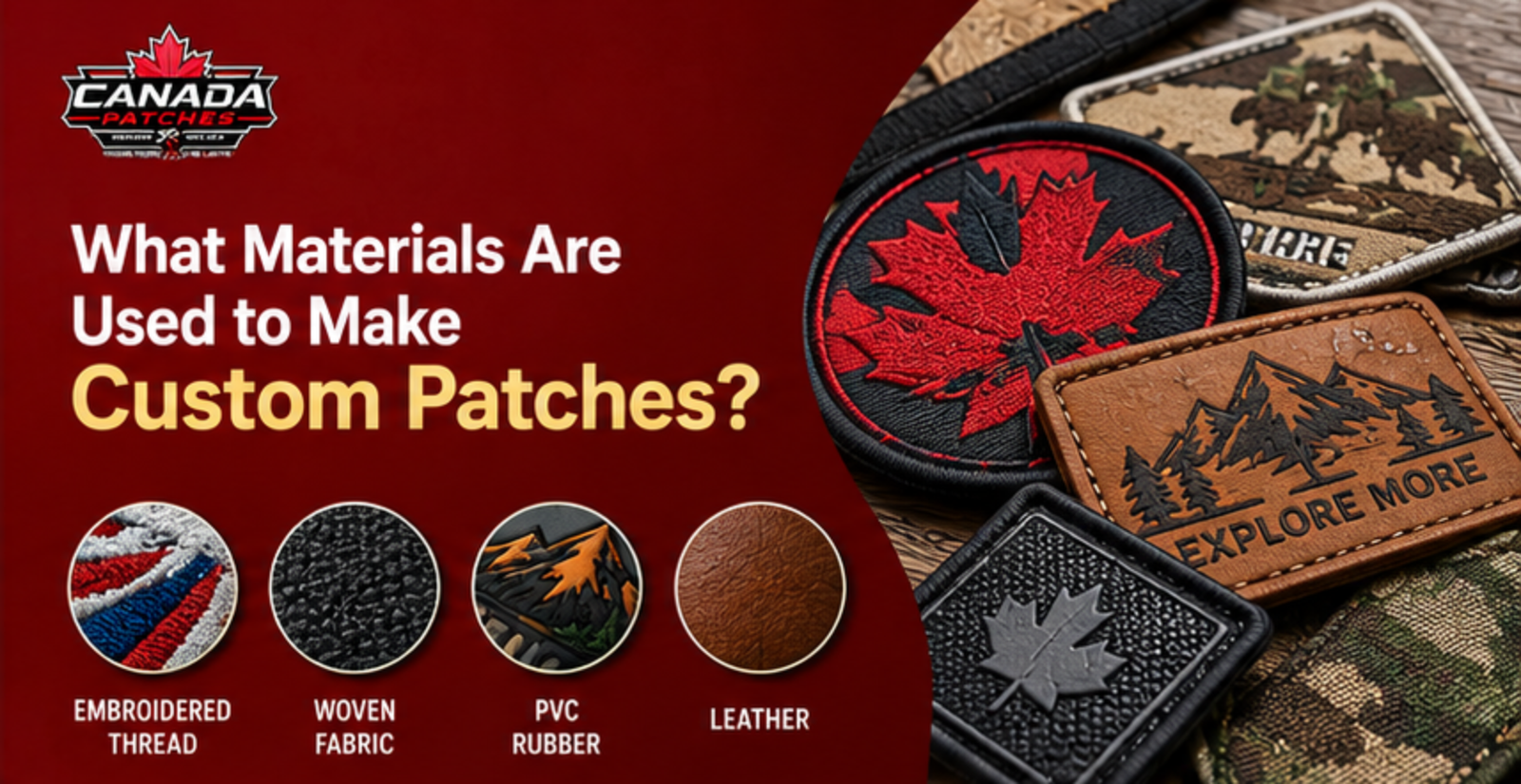
The materials to make custom patches are not limited to the visible surface. A finished patch can involve a fabric base, embroidery thread or printing substrate, border, backing, adhesive, and other construction elements.
These components affect several practical characteristics:
Texture: Chenille has a textured, raised finish, but sublimation results in a relatively smooth printing effect.
Color representation: Sublimation is especially suitable for images with gradations and multiple colors.
Readability: Bold embroidery makes letters clearly visible, while very fine details may call for another technique.
Application: Sew-on, iron-on, adhesive and hook-and-loop fastenings are possible options.
Durable use: The expected frequency of washing the clothes, as well as their material and usage conditions, need to be considered.
This is why patch selection should begin with the intended application rather than with the production technique alone.
When should you choose chenille for a varsity or sports design?
Chenille is a strong choice when texture and dimensional lettering are central to the design.
Its distinctive looped-yarn surface gives patches a soft, raised appearance that has become closely associated with varsity jackets, school athletics, collegiate apparel, and team recognition. Large initials, numbers, mascots, short words, and achievement symbols can benefit from this bold construction.
Custom chenille patches are generally most effective when the artwork uses clear shapes and substantial lettering. Fine outlines, tiny text, photographic imagery, and intricate gradients are less suited to the technique because chenille's visual character comes from its thick, tactile construction.
For a traditional school or sports aesthetic, however, that limitation can actually be an advantage. Simplifying artwork allows the texture and silhouette to become part of the design rather than treating them as obstacles.
What makes chenille letterman patches different from standard embroidered patches?
The primary difference is the surface structure.
Traditional embroidery builds the design with stitched thread, creating a defined stitched texture. Chenille uses looped yarn to produce a fuzzier, thicker, three-dimensional surface.
That makes chenille letterman patches particularly recognizable. They can emphasize large letters, numbers, school initials, team names, and symbols without relying on photographic detail.
The distinction also affects design decisions. A highly detailed logo may benefit from embroidery or sublimation, whereas a large athletic letter can become more visually powerful when rendered in chenille.
For this reason, varsity chenille patches Canada can be especially suitable for school teams, athletic programs, clubs, graduation apparel, and traditional letterman jackets where a substantial, classic appearance is desired.
Are sublimation patches Canada better for detailed artwork?
Not necessarily superior, but often better suited to complex artwork.
Sublimation patches Canada can come in handy where there are designs involving several colours, shading, shadows, drawings or pictures. Dye sublimation involves the use of heat to inject dye in the form of gas into a suitable substrate, whereby colour becomes integrated into the fabric and not just applied on it.
According to the industry information from Sawgrass, sublimation is the heat transfer method which is specifically designed for polyester substrates and other specially treated substrates.
This implies that sublimation is especially helpful in cases where the artwork cannot be duplicated by means of stitching.
The critical issue here is the substrate. In most cases, dye sublimation involves polyester substrates or specially treated substrates; thus, the substrate should be carefully assessed before production.
How do full-color dye sublimated patches reproduce complex designs?
Full-color dye sublimated patches are designed around colour reproduction rather than raised threadwork.
Rather than forming an image by piecing together multiple sections, it involves transferring a printed pattern to an appropriate surface through the use of heat. It is more likely to enable:
Photographic images
Illustrations
Colour gradations
Shadows and highlights
Multi-colour blends
Logos
Artwork
It should be noted that not all images will automatically give you a good patch as there are many factors that can affect the process including file quality, colour management, substrate choice, heat-press settings, and testing.
Sawgrass points out that the right substrates, calibrated heat press, colour management, and manufacturer settings are critical to ensure consistent sublimation.
How do you choose materials to make custom patches for different applications?
The materials to make custom patches should be selected after considering the garment and artwork together.
There is no single material combination that works for every project. The correct solution depends on the artwork, garment, application method, expected wear, and desired appearance.
What causes small details to disappear from a custom patch?
One of the most common design mistakes is treating a patch like a digital image that can be reproduced at any physical size.
Physical production has limitations. Very small lettering can become difficult to read. Extremely thin lines may lose definition. Similar colours can visually merge, and excessive detail can become crowded when reduced to a small patch.
Before manufacturing, check:
Is the smallest text actually readable?
Are important lines thick enough to remain visible?
Does the colour contrast work at the final size?
Does the border leave enough room around the artwork?
Does the chosen technique support the level of detail?
Will the design remain recognizable from a normal viewing distance?
These questions are particularly important when deciding between chenille and sublimation.
Can sublimation and chenille create the same design?
They can sometimes reproduce the same concept, but the finished appearance will be different.
Consider a school mascot. A chenille version might emphasize a bold silhouette, raised lettering, and a traditional athletic appearance. A sublimated version could preserve facial details, shading, gradients, and a much broader range of colours.
Neither is automatically superior.
The better choice depends on what the design needs to communicate. If the goal is heritage, texture, and varsity character, chenille may be the stronger direction. If the goal is detailed colour reproduction, sublimation may offer greater flexibility.
What should you ask a custom patches manufacturer Canada before production?
Choosing a custom patches manufacturer Canada becomes easier when you ask specific production questions before approving the artwork.
Ask:
Which patch technique is most appropriate for this artwork?
What minimum lettering size do you recommend?
Which backing options are available?
Can the design be simplified without changing its identity?
What artwork file format and resolution do you need?
Will I receive a digital proof before production?
How will colours be handled during production?
Is the recommended substrate appropriate for the intended garment?
What application method is best for the expected use?
Are production samples available for larger or repeat orders?
These questions shift the conversation from simply ordering a patch to planning a successful finished product.
How should artwork be prepared before ordering?
Start with the best version of your artwork that you have.
Vector-based artwork is ideal for logos, lettering, and other graphic elements that need to maintain their basic shape through enlargement. Raster-based artwork is also acceptable for sublimation as long as it comes in at the proper resolution.
It is important to understand that what your artwork looks like on the screen will not always tell you everything about the way it will look once it is made into a patch.
When it comes to chenille patches, simple graphics are generally easier to read than complicated graphics. When it comes to sublimation, keeping the details might be more important.
Which patch technique is best for Canadian sports teams and schools?
It would depend on what the patch is used for.
For athletic letters, school initials, graduation patches and the classic design of a varsity jacket, chenille would create a unique look with its raised effect. In order to allow greater artistic liberty with intricate details of team logos, event designs, photos and multiple colored illustrations, sublimation can be employed.
It is possible that both techniques could be employed by schools and sports organizations in their entire apparel program. The chenille technique can be used for the letters of the varsity jacket and sublimation technique for the tournament or memorial designs.
That approach recognizes an important principle: patch techniques do not have to compete with one another. They can solve different design problems.
How can you make custom patches more durable and visually consistent?
Durability starts even before manufacturing.
Consider what patch construction is needed based on the type of garment, how often it will be used, washing process, and how the patch will be applied. Patches used decoratively and not often may need a different kind than patches sewn into frequently-washed team clothing.
For sublimation printing in particular, heat-pressing parameters should match the substrate and equipment manufacturers' instructions. Sawgrass stresses that temperature set incorrectly can lead to color-related problems, poor image transfer, or even a failure to transfer at all.
Proofing of the order ahead of full manufacturing can be helpful when ordering large quantities of patches.
What is the smartest way to select Canada custom patches?
Start with four questions:
What is the patch going to be used for?
A varsity jacket patch, a sports team uniform, a working uniform, a promotional product, and a collectors' item will all have very different needs.
How complex is the graphic element?
Something that works well on lettering might not work well on chenille, and something that works on intricate designs might need sublimation.
What is the desired touch?
Go for something tactile when texture is critical, and choose something smooth and printed when colour accuracy is more important.
What is the intended use and maintenance?
The backing and garment should work together with the expected frequency of use and care.
Ultimately, successful Canada custom patches come from matching the design to the production method rather than forcing every design into the same process.
Final takeaway: should you choose sublimation or chenille?
Both sublimation and chenille address entirely different design needs.
Use chenille if you need texture, bold text, depth and an old-fashioned look of a varsity jacket patch. Use sublimation for designs requiring reproduction in full colour, gradients, complex artwork, and photography.
The key to making the best custom patches is knowing the materials used in patch making process and how each of those affects the final product. Taking into account the complexity of design, material of the garment, and application methods, the decision becomes obvious.
When deciding on the right technique for teams, schools, clubs, businesses, and individual customers, the aim shouldn’t be to make the process the most complicated one but rather to choose the method that retains the identity of the artwork and provides necessary qualities of the patch.