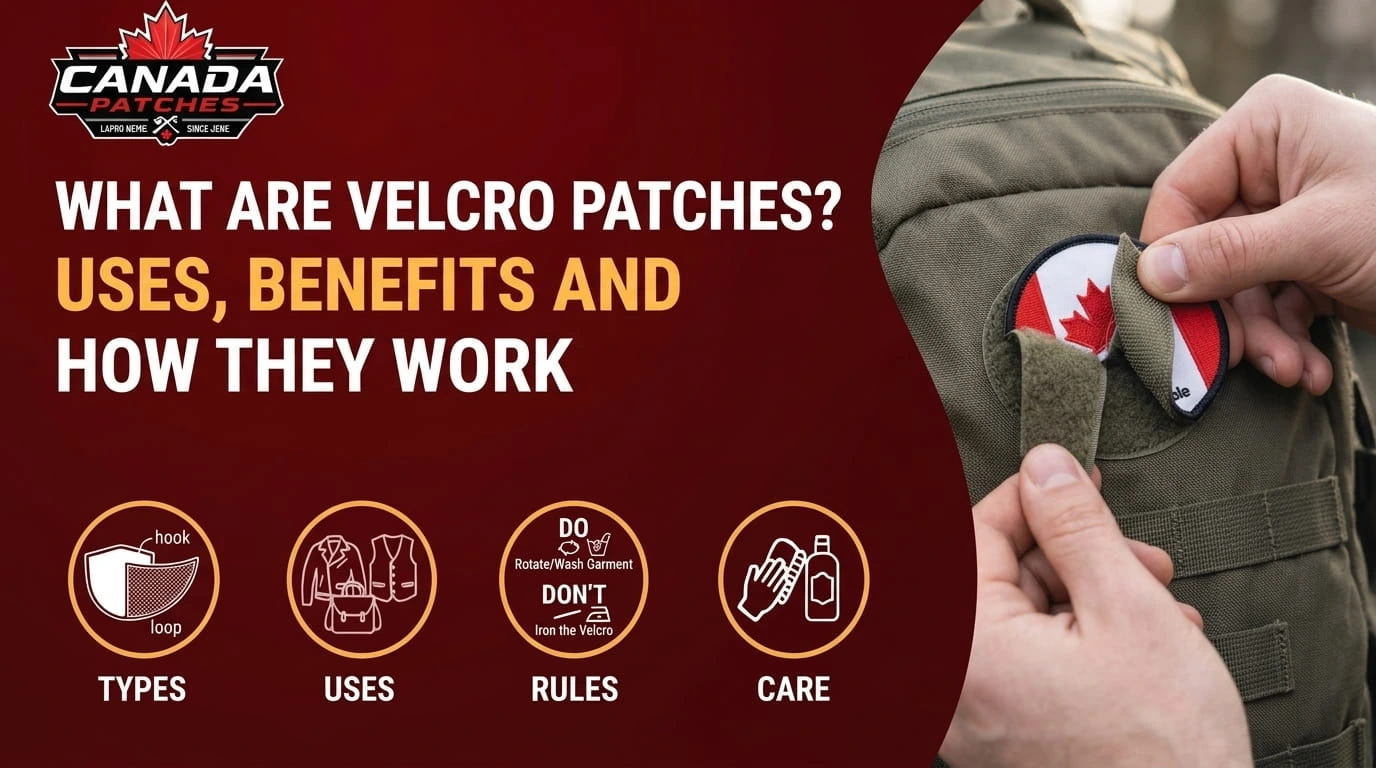
Velcro patches are a type of fabric badge that can be attached to corresponding hook-and-loop surfaces; therefore, people can place, take off, and put back patches without constant sewing and destruction of their clothes and equipment. The question: What are Velcro patches? may arise in the case when people need something like a patch that can be changed without problems.
As opposed to sewn-on and iron-on badges, these patches have a system that includes two parts of specially created fabric surfaces; one surface has small hooks and another has smooth loops catching these hooks and forming a fastening system.
How Do Hook-and-Loop Patch Systems Work?
Hook and loop patches use a mechanical fastening system consisting of two complementary materials. The hook side contains small, flexible projections, while the loop side features numerous tiny fabric fibers. When both surfaces come into contact, the hooks catch the loops and create multiple small connections that hold the patch in place.
The procedure for attaching the patches is quite simple and no needles, threads, or adhesives need to be used.
A fastener consists of the following parts:
Front (decorative): The part that is designed with embroidery, logo, letters, symbols, or identification information.
Hook (backing): This is the rough fastener that is placed at the back of the patch.
Loop (receiving surface): The soft fabric that is put on a backpack, uniform, or jacket.
These components work together to provide a convenient attachment method. When the patch needs to be changed, users can separate the surfaces by pulling the patch away from the receiving panel.
Understanding hook-and-loop patch backing helps users identify the correct hook and loop components and attach interchangeable badges to compatible clothing and equipment.
Why Does the Hook-and-Loop Mechanism Hold Patches Securely?
The fastening strength comes from the interaction of numerous small hooks and loops rather than a single attachment point. When pressed together, these connections distribute the holding force across the contact area.
Some elements play an important role in determining how strongly a patch attaches to something:
Size of contact surfaces: Large compatible surfaces allow more points of attachment.
Quality of materials: Good fastening fibers allow creating a strong bond.
Condition of the surface: Dirt or fiber fragments prevent proper attachment.
Pressure: Compression of surfaces allows forming better connections.
Weight of the patch: Heavy patches need more area for attaching.
Understanding these factors helps users select suitable materials for everyday accessories and demanding applications.
What Are Velcro Patches Used For in Everyday Life?
Understanding what velcro patches are used for makes it easier to identify situations where interchangeable identification and decoration provide practical value. These products are not limited to military uniforms or tactical equipment. They are also useful for personal accessories, professional clothing, sports gear, and organizational purposes.
1. Military and Tactical Equipment
Military personnel and users of tactical gear require ID badges that can be updated based on their mission or operation. The interchangeable design makes it easier to have names, unit identification badges, and even national flags.
Such ID badges are mounted on compatible uniforms, tactical vests, plate carriers, and gear bags. Tactical users can consider custom Velcro patches for tactical vests when they need interchangeable identification, unit insignias, or organisational designs on compatible gear.
Their detachable construction allows users to change identification without repeatedly stitching new designs onto their clothing. For specialised equipment and authorised uniform applications, custom military identification patches can feature unit insignias, names, symbols, and other identification details with suitable backing specifications.
2. Backpacks and Travel Accessories
Backpacks provide another practical application because users often want to personalize their belongings without permanently modifying the material.
For example, custom velcro patches for backpacks allow students, travelers, outdoor enthusiasts, and professionals to display different designs according to their interests. These may include names, initials, decorative artwork, brand symbols, and travel-related graphics.
It is also much easier to coordinate several different designs because of the designated fabric attachment section.
3. Workplace Uniforms and Professional Clothing
Businesses can use interchangeable identification badges to display employee names, department details, and organizational branding.
It is especially useful in circumstances where several workers are to use the same equipment or when the requirement for identification changes from department to department. There is no need to replace the whole uniform, just the badge that it carries.
4. Sports Teams and Recreational Clubs
Sports organizations, outdoor clubs, and recreational groups can use interchangeable insignia to display membership details, team identities, event information, and achievements.
The ability to update designs makes these fastening systems useful for clothing and accessories that serve different activities.
Are No-Sew Patches Better Than Traditional Sew-On Designs?
No sew patches provide an attachment option that does not require stitching through the underlying garment. However, whether they are better than traditional alternatives depends on the intended application, required durability, and frequency of design changes.
Sew-On Patch
Traditionally made sew-on patches can be used for long-term applications. The removal of such patches requires the cutting of stitches.
Iron-on designs use heat-activated adhesive to bond with compatible materials. Although convenient, they are not usually intended for repeated removal and replacement.
The hook-and-loop option is more flexible since the joining surfaces can be detached without unstitching or detaching the adhesive. Before deciding on an attachment method, explore the different types of custom patches to understand how embroidery, woven, PVC, and other constructions differ in appearance and application.
Comparison of Different Patch Attachment Methods
Feature | Hook-and-Loop Patches | Sew-On Patches | Iron-On Patches |
Way of attachment | Mechanical attachment | Needle and thread | Heat-activated adhesive |
Application process | Attaching to matching surface | Stitching is required | Application using heat and pressure |
Removal process | Simple detachment | Unstitching is necessary | Sometimes problematic |
Reusable | Designed for reuse | Not easily reusable after removal | Not reusable |
Most suitable use | Tactical equipment, bags, uniforms | Permanent decoration | Customization of clothing |
Maintenance | Cleaning of the joining surfaces | Checking stitching | Heat care requirements |
When Should You Choose a Detachable Fastening System?
When there is the need to change the information that a particular piece of clothing or accessories holds, it becomes very convenient to use a design that allows for detachability.
It means that for different journeys, one can prefer to have a different pattern, and in some instances like changing ID information, it might be necessary.
However, if an item requires a permanent attachment that can withstand frequent washing, heavy friction, or demanding physical activity, traditional stitching may be more appropriate.
What Are the Main Benefits of Removable Patch Systems?
One of the biggest advantages of interchangeable fastening is the ability to customize existing belongings without purchasing new clothing or accessories.
Removable patches provide several practical benefits for people who regularly update their equipment or personal designs.
Easy Design Replacement
An individual user can unmount the existing badge from a web page and replace it with another badge in less than a second.
Less Permanent Fabric Modification
Unlike repeated stitching, this fastening method does not require making additional needle holes whenever a design is changed. It can therefore help preserve the original appearance of compatible clothing and accessories.
Reusable Construction
Fastening materials that are of good quality will be able to endure the constant process of attaching and detaching. How long such materials last depends on several factors.
Flexible Personalization
Users can select different designs for professional identification, personal expression, outdoor activities, and organizational branding.
Convenient Organization
Various design options may be kept separately and chosen according to the event or situation. This will help those who have multiple badges that they can interchange.
What Is a Modular Patch Panel and Why Is It Useful?
A modular patch panel is a dedicated fabric surface designed to accommodate multiple interchangeable badges in an organized arrangement. It usually features loop material that accepts compatible hook-backed designs.
Such patches are often sewn into tactical packs, organizational gear, uniforms, and other special pieces of equipment.
For instance, one may have a patch on the front side of the pack that contains a name badge, a flag, a symbol, and an identification patch. The configuration is easily adjustable.
What Should You Check Before Choosing a Patch Panel?
Selecting a suitable panel involves more than considering its appearance. Compatibility, dimensions, and material quality also influence its performance.
These should be considered:
Panel size: Ensure that there is sufficient space to accommodate the required patch sizes.
Fabric material: Select fabric that is tough and can withstand frequent attachment and detachment.
Fastener compatibility: Ensure that the back of the patch is compatible with the attachment surface.
Positioning: Select a location that is accessible and does not obstruct zippers or other clothing elements.
The right choice of the panel is fundamental to creating an effective base for interchangeable accessories.
How Do You Choose the Right Velcro Patch?
Choosing a suitable patch depends on its purpose, attachment surface, design requirements, and expected conditions of use. When comparing attachment methods, choosing the right patch backing requires checking fabric compatibility, expected usage, patch weight, and whether the design needs to be removable.
1. Select the Appropriate Size
The size of the adhesive tape must be comfortable to use in the attachment region. A large size could exceed the reception region thus minimizing the effective contact region.
2. Check the Backing Compatibility
Before purchasing, confirm that the patch has a suitable hook backing and that the intended garment or accessory contains a compatible loop surface.
Ordinary cotton, denim, polyester, and leather do not automatically provide the required fastening surface.
3. Compare Different Patch Materials
The design of the front affects the look, details, and performance of the patch.
Embroidered patches: Have a raised and textured design due to stitching.
Woven patches: Have more detailed lettering and artwork.
Printed patches: Can have complicated illustrations with gradients and details of colors.
The best choice will be based on the design and amount of details.
4. Consider Durability
Think about how frequently the patch will be removed, exposed to outdoor conditions, or subjected to friction. Strong backing material and carefully finished edges can help improve its useful life.
5. Match the Design to Its Purpose
A badge that is meant to be used to decorate a backpack can have different criteria when compared to one that is meant for ID purposes on professional equipment.
How Can You Maintain Hook-and-Loop Patches?
Regular maintenance helps preserve fastening strength and keeps decorative surfaces in good condition.
Please pay attention to the following advice:
Regularly remove lint, dust, and other particles from the hook side.
It is important to keep the loop side clean to avoid any dirt that could hinder the fastening process.
Separation should be avoided when there is no need to change the patch.
Unused patches should be stored in a dry place.
Please follow the manufacturer's guidelines for cleaning the patch.
Periodically check the backing for worn-out or damaged fibers.
In case the patch stops sticking well, please check both fastening sides for dirt accumulation. The problem could be solved by cleaning the surfaces, though replacement may become necessary for severely worn patches.
Frequently Asked Questions About Velcro Patches
1. Can Velcro patches be reused?
Certainly. They are made to be attached and detached multiple times from compatible surfaces. The longevity of their use depends on their quality and maintenance.
2. Do Velcro patches stick to every type of fabric?
No. They require a compatible receiving surface, usually a loop-fabric panel. Ordinary clothing materials generally need an additional loop backing before they can support this fastening system.
3. Can Velcro patches be washed?
Cleaning depends on the patch construction and manufacturer's instructions. Gentle cleaning may be suitable for some designs, but excessive heat, harsh chemicals, and improper washing can damage the decorative surface or fastening fibers.
4. Do Velcro patches fall off easily?
Quality patches generally remain attached during ordinary use when properly matched and secured. However, incorrect sizing, worn fastening material, accumulated dirt, and insufficient contact can reduce their holding strength.
5. Can you attach Velcro patches to a regular backpack?
Yes, but the backpack needs a compatible loop panel or receiving surface. Some backpacks include dedicated attachment areas, while others may require a separately installed loop panel.
6. Are Velcro patches suitable for tactical equipment?
Absolutely. They have been used extensively for interchangeable identification tags, name badges, organizational insignias, and decorative insignias for compatible uniforms and equipment.
Conclusion
Velcro patches offer a practical way to personalize clothing, identify equipment, and update decorative designs without permanent stitching. Their hook-and-loop fastening mechanism makes them useful for backpacks, tactical equipment, professional uniforms, sports accessories, and everyday customization.
Knowing what velcro patches will help users determine the appropriate way to attach the item. Whether one seeks to have interchangeability, reusability or equipment customization, knowing how to make an appropriate choice with regards to surfaces and materials matters much.
Get to experience some options in customization through Canada Patches.